IBM i (formerly OS/400 and i5/OS) and Linux are both robust operating systems, but they stem from fundamentally different design philosophies. IBM i, developed by IBM for its Power Systems hardware, emphasizes integration, security, and long-term stability for enterprise workloads, evolving from the AS/400 lineage since 1988. Linux, an open-source Unix-like kernel created by Linus Torvalds in 1991, powers a vast ecosystem of distributions (e.g., Red Hat, Ubuntu) and runs on diverse hardware from x86 to ARM and Power. This comparison dives deep into their architectures, focusing on kernel internals, memory management, file systems, security, performance, and more, drawing from technical analyses and user insights. As of January 2026, IBM i remains proprietary and hardware-specific (Power Systems), while Linux’s openness drives its ubiquity.
Table of Contents
Kernel and Core Architecture
IBM i and Linux differ profoundly in their kernel designs, with IBM i prioritizing hardware abstraction and integration, while Linux focuses on modularity and portability.
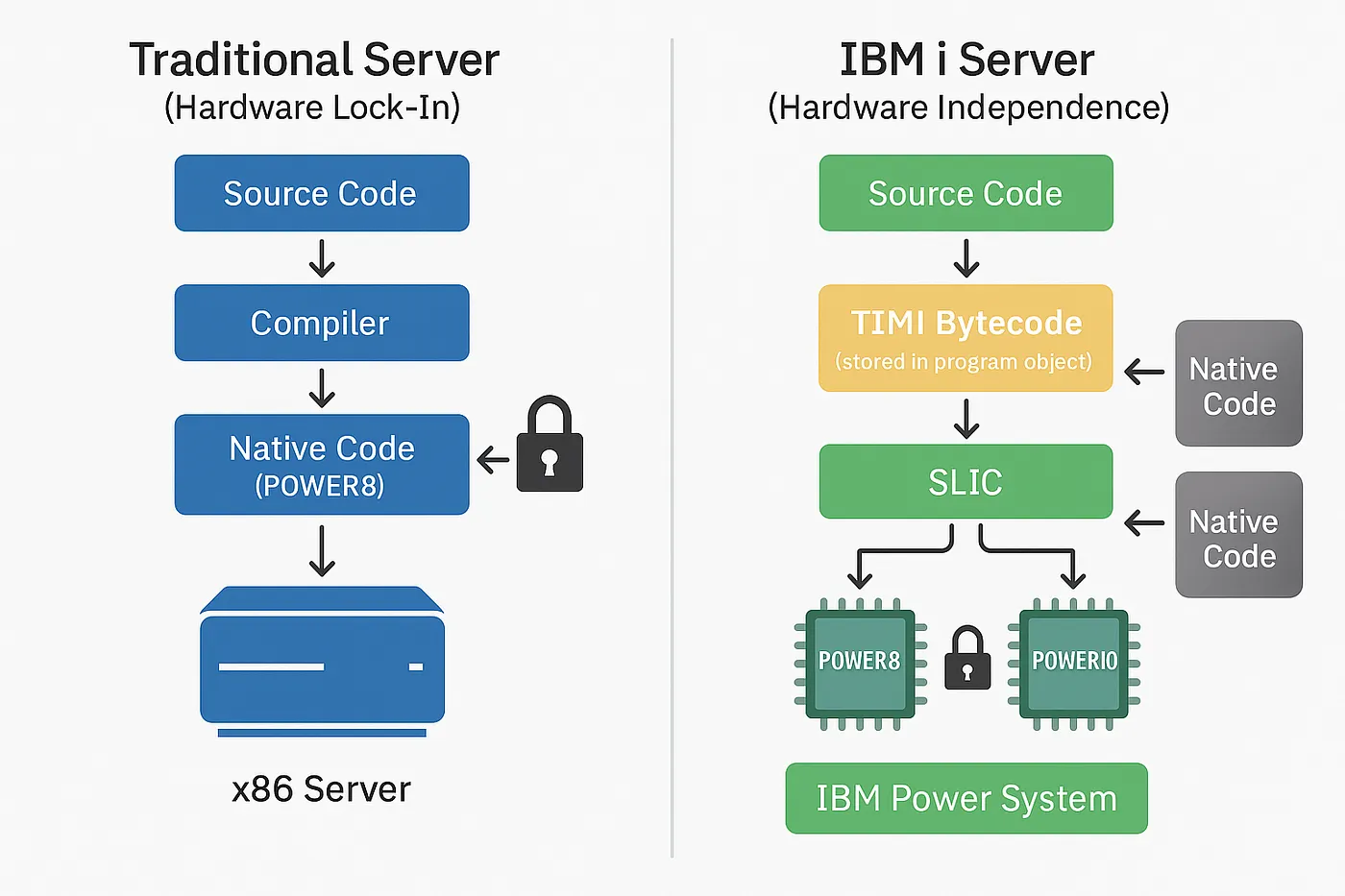
- IBM i: Microkernel-Like with SLIC and TIMI IBM i’s core is the System Licensed Internal Code (SLIC), a proprietary, closed-source layer that functions like a microkernel but with extensive capabilities. SLIC handles low-level tasks such as process management, I/O, security, and storage, operating at the hypervisor level (via PowerVM) to support logical partitions (LPARs) for isolated environments. Above SLIC sits the Technology Independent Machine Interface (TIMI), an intermediate bytecode layer where compilers (e.g., for RPG, COBOL) generate hardware-agnostic instructions instead of native code. TIMI instructions are translated ahead-of-time by SLIC into optimized native code for the current Power processor (e.g., POWER11), with results cached for efficiency. This dual-layer approach (TIMI for abstraction, SLIC for execution) enables seamless hardware upgrades without recompilation—programs from 1988 can run on modern hardware via automatic TIMI translation. SLIC’s overhead is minimal (1-3% in multi-LPAR setups), and it’s not user-modifiable, ensuring stability but limiting customization.
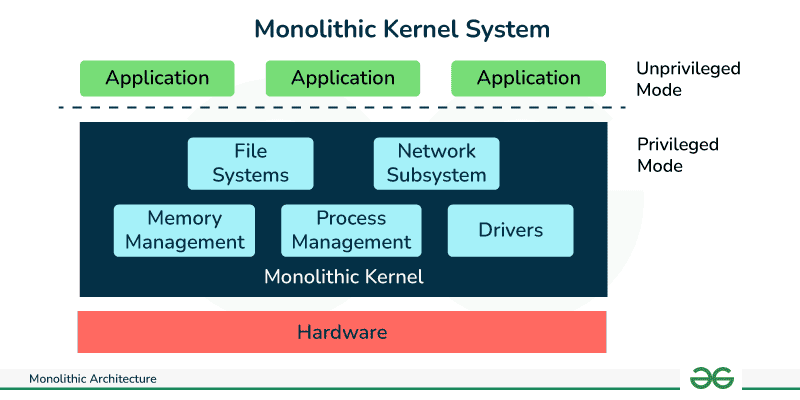
- Linux: Monolithic Kernel with Modular Extensions The Linux kernel is monolithic, meaning it runs as a single, large process in kernel space, handling everything from memory allocation to device drivers in one address space. It’s open-source, allowing developers to inspect, modify, and compile it for specific needs (e.g., kernel 6.x series as of 2026). Modularity comes via loadable kernel modules (LKMs) for drivers and features, enabling runtime extensions without rebooting. Unlike IBM i’s TIMI, Linux compiles directly to native machine code for the target architecture, requiring recompilation or cross-compilation for hardware changes. Virtualization is handled separately (e.g., via KVM or containers like Docker), not integrated as deeply as IBM i’s LPARs.
- Key Differences: IBM i’s SLIC/TIMI model decouples applications from hardware, offering superior backward compatibility (e.g., 30+ years of binaries) but at the cost of proprietary opacity. Linux’s kernel is transparent and extensible, fostering innovation but demanding more maintenance for hardware shifts. On Power Systems, Linux runs natively but lacks IBM i’s deep integration. Recent developments include IBM’s exploration of a Linux-like Portable Application Solutions Environment (PASE) for IBM i, blending Unix compatibility with SLIC.
Memory Management
Memory handling highlights IBM i’s unified approach versus Linux’s segmented one.
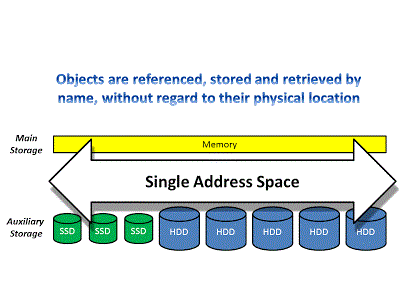
- IBM i: Single-Level Storage (SLS) SLS treats all storage (RAM and disk) as a single, vast virtual address space, eliminating the file/memory distinction. Objects are addressed directly via 128-bit pointers, with SLIC automatically paging data between RAM and disk without application involvement. This simplifies programming—no explicit file I/O or memory allocation—and enhances performance for large datasets, as the system optimizes caching globally.
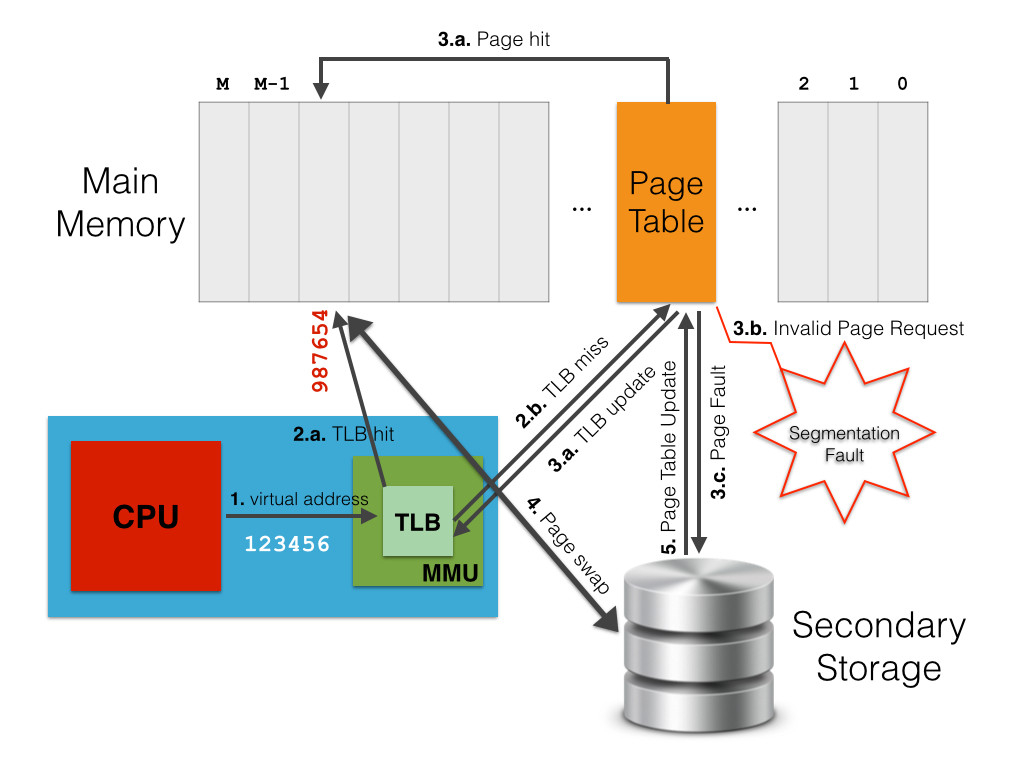
- Linux: Virtual Memory with Paging and Swapping Linux uses virtual memory to abstract physical RAM, dividing it into pages managed by the kernel. Processes have private address spaces, with swapping to disk (via swap partitions) when RAM is low. Tools like nice (20 levels) adjust priorities, but it’s less granular than IBM i’s 100 levels. Advanced features include cgroups for resource limiting and huge pages for efficiency.
- Key Differences: IBM i’s SLS provides “unlimited” storage abstraction and automatic persistence, ideal for databases, but requires Power hardware. Linux’s model is more flexible across hardware but demands explicit management, leading to potential fragmentation or overcommitment issues.
File System and Object Model
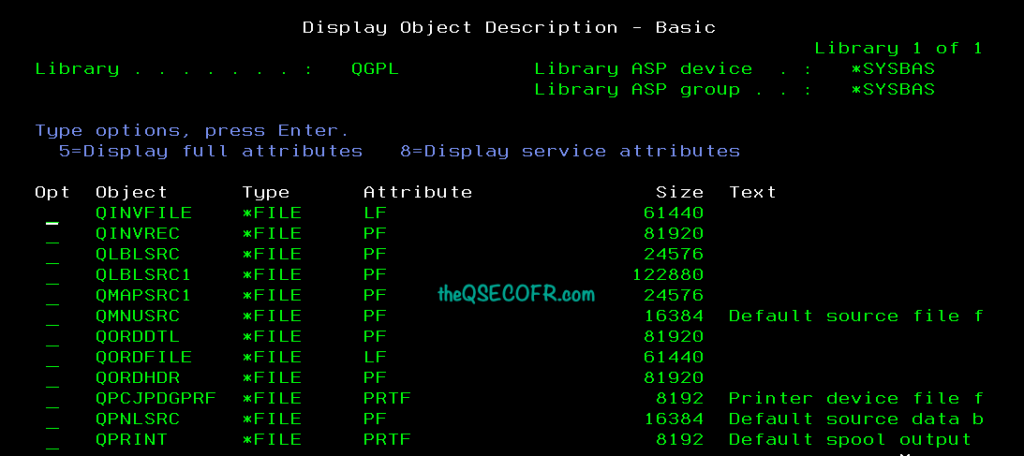
- IBM i: Object-Based with Integrated File System (IFS) Everything is an object (*FILE, *PGM, etc.) with encapsulated data, types, and authorities, residing in libraries (*LIB). Files are record-oriented (e.g., physical/logical files in Db2 for i), with IFS providing a Unix-like hierarchical structure for compatibility. This model enforces type safety and security inherently.
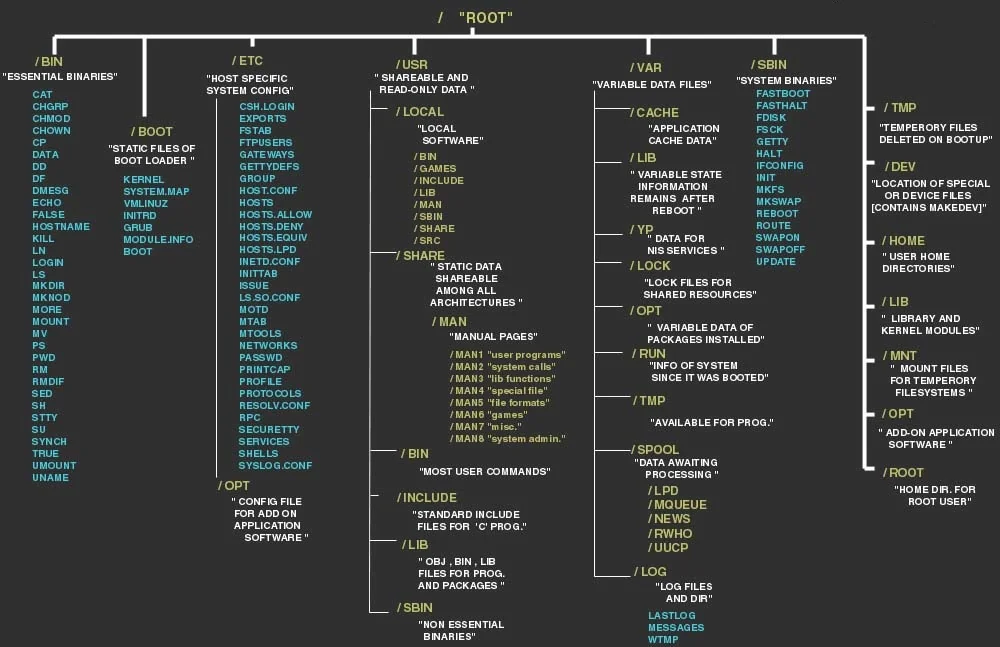
- Linux: Hierarchical File Systems (e.g., ext4, Btrfs) Files are byte streams in a tree structure starting from /, with inodes tracking metadata. No native object encapsulation; security relies on permissions (chmod) and extensions like ACLs or AppArmor.
- Key Differences: IBM i’s objects enhance security and integration (e.g., no “everything is a file” philosophy like Unix), reducing vulnerabilities. Linux’s file system is more universal, supporting diverse formats and easier for general-purpose computing.
Database Integration
- IBM i: Db2 for i is embedded in SLIC, treating tables as objects for seamless access via SQL or native languages like RPG. It’s self-maintaining, handling billions of transactions with built-in journaling.
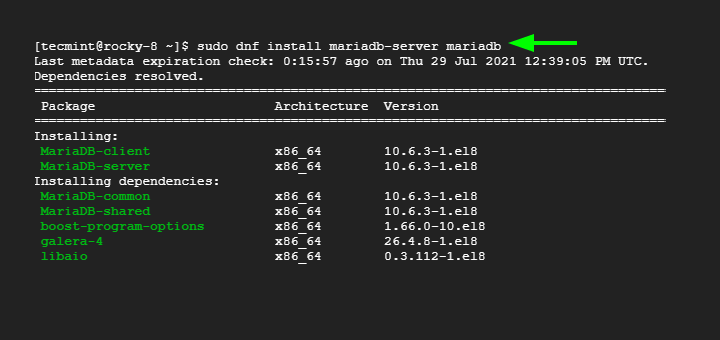
- Linux: Databases (e.g., MySQL, PostgreSQL) are user-space applications, requiring separate installation and management.
- Key Differences: IBM i’s integration lowers overhead and boosts reliability for business apps; Linux offers choice but more setup.
Security
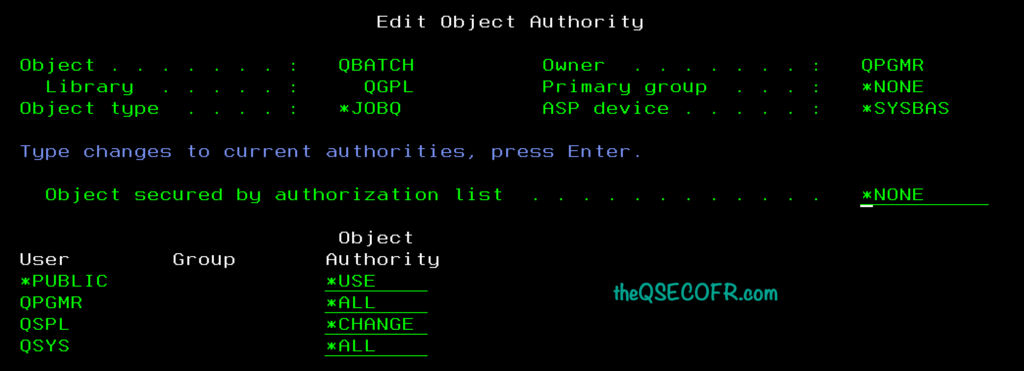
- IBM i: Object-based security with granular authorities (e.g., *USE, *CHANGE) and auditing; inherently virus-resistant due to encapsulation.
- Linux: POSIX permissions, SELinux for mandatory access control, and firewalls; strong but requires configuration.
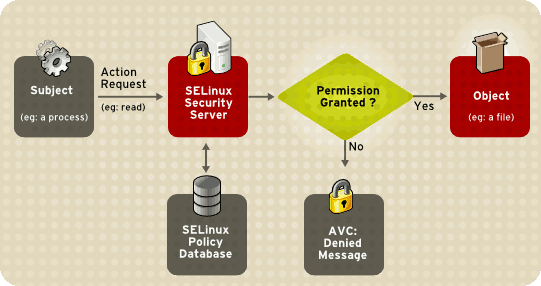
- Key Differences: IBM i is “securable” out-of-the-box; Linux is flexible but prone to misconfiguration.
Performance and Scalability
IBM i excels in transactional workloads on Power hardware, with low TCO (one box vs. multiple Linux servers). Linux scales horizontally via clusters, offering better price/performance on commodity hardware. On Power, Linux benefits from IBM optimizations but lacks IBM i’s efficiency.
Portability, Compatibility, and Ecosystem
IBM i ensures binary compatibility across generations but is Power-only. Linux runs everywhere, with vast open-source tools, though distributions fragment the ecosystem. IBM i supports PASE for AIX/Linux apps; Linux has no equivalent for IBM i natives.
Use Cases and Pros/Cons
- IBM i
- Pros: High reliability, integrated database, low maintenance for ERP/finance; “set it and forget it.”
- Cons: Expensive licensing, complicated documentation, skills shortage, legacy stigma.
- Linux
- Pros: Free, versatile, massive community; ideal for web, cloud, IoT.
- Cons: Higher management overhead, potential instability in complex setups.
In summary, IBM i is a tightly integrated, secure powerhouse for mission-critical apps, while Linux offers flexibility and cost savings for diverse environments. Choice depends on workload: IBM i for stability, Linux for innovation.
- Wikipedia: IBM i (detailed layers: SLIC, TIMI, XPF) https://en.wikipedia.org/wiki/IBM_i
- Medium: IBM i Architecture: How TIMI and SLIC enable hardware independence (2025 article) https://medium.com/@dhemanthc/ibm-i-architecture-how-timi-and-slic-enable-hardware-independence-82aea3f2dae3
- Wikipedia: Monolithic kernel (Linux as monolithic) https://en.wikipedia.org/wiki/Monolithic_kernel
- Stack Overflow: Why is Linux called a monolithic kernel? https://stackoverflow.com/questions/1806585/why-is-linux-called-a-monolithic-kernel
- Wikipedia: Single-level store https://en.wikipedia.org/wiki/Single-level_store
- Source Data: What Is IBM i Single Level Storage? And Why Should I Care? https://source-data.com/2020/04/27/what-is-ibm-i-iseries-as400-single-level-storage-and-why-should-i-care/
- Integrative Systems: Why Should you Care About IBMi Single Level Storage? https://www.integrativesystems.com/ibmi-single-level-storage/
- Wikipedia: IBM i (TIMI for hardware abstraction and binary compatibility) https://en.wikipedia.org/wiki/IBM_i
- LANSA: What is an AS/400? (TIMI explanation) https://lansa.com/blog/application-modernization/what-is-an-as400/
- IT Jungle: FAX/400 And CICS For i Are Dead (discusses TIMI’s role in compatibility) https://www.itjungle.com/2025/05/19/fax-400-and-cics-for-i-are-dead-what-will-ibm-kill-next/
- Wikipedia: IBM Db2 (tight integration in IBM i) https://en.wikipedia.org/wiki/IBM_Db2
- Reddit r/IBMi: Discussions on integrated stack vs. separate databases in Linux https://www.reddit.com/r/IBMi/comments/pbnumw/how_is_ibm_i_better_than_linux/
- IBM Support: IBM i Security https://www.ibm.com/support/pages/ibm-i-security
- Reddit r/IBMi: How is IBM i better than Linux? (object-based security) https://www.reddit.com/r/IBMi/comments/pbnumw/how_is_ibm_i_better_than_linux/
- IBM Docs: Introduction to IBM i security https://www.ibm.com/docs/en/i/7.5.0?topic=reference-introduction-i-security
- Reddit r/IBMi: How is IBM i better than Linux? (reliability, TCO, integration) https://www.reddit.com/r/IBMi/comments/pbnumw/how_is_ibm_i_better_than_linux/
- Reddit r/IBMi: What is the performance of IBM i compared to Linux? https://www.reddit.com/r/IBMi/comments/w5hwu0/what_is_the_performance_of_ibm_i_compared_to_linux/
- IBM Blogs: Top IBM Power Systems myths (Linux on Power vs. x86) https://www.ibm.com/blogs/systems/top-ibm-power-systems-myths-linux-on-x-86-is-different-from-linux-on-power/