In the vast landscape of cybersecurity, one concept stands out for its elegance and power: Elliptic Curve Cryptography (ECC). While the name might sound intimidating, the principles behind ECC are surprisingly beautiful and incredibly effective, has become one of the most trusted cryptographic techniques in use today.
ECC is not new, but its importance has grown rapidly with cloud computing, mobile devices, IoT, and the move toward post-quantum readiness. This blog post explains where ECC came from, how it works mathematically, how it is used in encryption and key exchange, and why it is more secure than RSA and other cryptographic systems.
Table of Contents
History
The story of elliptic curves isn’t a modern one; it stretches back centuries. Mathematicians like Diophantus of Alexandria in ancient Greece studied these curves, primarily for their intriguing properties related to integer solutions. Fast forward to the 17th century, and the likes of Newton and Fermat further explored their characteristics. Elliptic curves first appeared in mathematics in the 19th century, studied by mathematicians like Karl Weierstrass. For decades, elliptic curves existed only as abstract mathematical objects until the mid-20th century that the true cryptographic potential of these elegant mathematical structures began to be realized.
In 1985, two researchers independently changed everything:
- Neal Koblitz
- Victor Miller
They proposed using elliptic curves for cryptography. Their idea was simple but powerful: This groundbreaking idea revolutionized public-key cryptography, offering a more efficient and secure alternative to existing methods like RSA.
Certain mathematical problems on elliptic curves are extremely hard to solve, even with modern computers. At first, ECC adoption was slow. RSA dominated public-key cryptography, and ECC math seemed complex. However, by the early 2000s, researchers and governments realized that ECC could provide equal or better security with much smaller key sizes.
Today, ECC is widely used in:
- TLS/SSL
- Mobile devices
- Cryptocurrencies
- Smart cards
- Secure messaging apps
- Government and military systems
What Is Elliptic Curve Cryptography?
Elliptic Curve Cryptography is a public-key cryptography system based on the algebraic structure of elliptic curves over finite fields.

In simple terms:
- ECC uses points on a curve
- Security relies on elliptic curve discrete logarithm problem (ECDLP)
- Calculating a public key from a private key is easy
- Reversing that process is practically impossible
The Mathematics Behind the Magic: What is an Elliptic Curve?
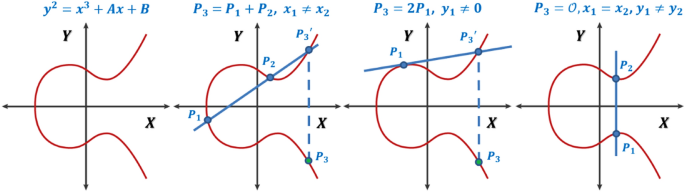
At its heart, an elliptic curve is defined by an equation of the form:
y^2 = x^3 + ax + b
where a and b are constants, and the curve does not have any singular points (sharp corners or self-intersections). These curves possess a remarkable property: any straight line that intersects the curve at two points will also intersect it at a third point. This geometric property is the foundation of ECC.
Key Concepts You Need to Know
- Points on the Curve – A point
(x,y)lies on the curve if it satisfies the equation. - Point Addition – You can add two points on the curve and get a third point, also on the curve. Imagine two points and on the curve. To add them, draw a line through both; it intersects the curve at a third point . Reflect over the x-axis to get . If , it’s point doubling—use a tangent line instead.
- Scalar Multiplication – This is the core of ECC. This is repeated addition: (k times). Here, is a large integer (your private key), and the result is your public key.
Q=k×P
P= a known base pointk= a large random number (private key)Q= resulting point (public key)
Scalar multiplication is easy to compute but extremely hard to reverse. No efficient algorithm exists to solve this for large values of k.
How ECC Works: The Discreet Charm of the Scalar Multiplication
The fundamental operation in ECC is scalar multiplication. This involves “adding” a point to itself multiple times. For example, nP means adding the point P to itself n times. While this operation is straightforward to perform in one direction (given n and P, calculate nP), the inverse problem – given P and nP, find n – is computationally extremely difficult. NThis is known as the Elliptic Curve Discrete Logarithm Problem (ECDLP), and it’s the bedrock of ECC’s security.
Even with massive computing power:
- Brute force is impractical
- No shortcuts exist like those used against RSA
This makes ECC highly resistant to attacks.
Here’s a high-level breakdown:
- Key Generation:
- Choose a standardized elliptic curve (e.g., NIST P-256) and a base point .
- Pick a random private key (a large integer).
- Compute the public key via scalar multiplication.
- Encryption and Decryption (via Elliptic Curve Integrated Encryption Scheme or similar hybrids):
- ECC is often used for key exchange or signatures rather than direct encryption, but let’s focus on Elliptic Curve Diffie-Hellman (ECDH) for key agreement, which enables encryption.
- Alice and Bob each have private keys and , and public keys and .
- Alice computes the shared secret: .
- Bob computes the same: .
- This shared secret (a point) is hashed to derive a symmetric key for algorithms like AES.
- To encrypt: Alice uses the symmetric key to encrypt a message with AES.
- To decrypt: Bob uses the same key to decrypt.
Here’s a simplified overview of how ECC is used for key exchange (like in Diffie-Hellman):
- Agreement on Parameters: Alice and Bob agree on a specific elliptic curve and a “base point” on that curve. This information is public.
- Private Key Generation:
- Alice chooses a random secret integer as her private key.
- Bob chooses a random secret integer as his private key.
- Public Key Generation:
- Alice computes her public key .
- Bob computes his public key .
- Shared Secret Calculation:
- Alice computes
- Bob computes
Because of the associative property of scalar multiplication, . Thus, Alice and Bob arrive at the same shared secret point , which can then be used to derive a symmetric encryption key. An eavesdropper, even knowing , and , cannot easily determine , or due to the ECDLP.
ECC in Action: Encryption, Decryption, and Digital Signatures
ECC isn’t just for key exchange; it’s also used for cryptographic operations like:
- Authentication
- Encryption and Decryption (using ECIES – Elliptic Curve Integrated Encryption Scheme): ECIES combines ECC with symmetric encryption. A sender uses the recipient’s public key to encrypt a symmetric key, which then encrypts the actual message. The recipient uses their private key to decrypt the symmetric key and subsequently the message.
- Digital Signatures (using ECDSA – Elliptic Curve Digital Signature Algorithm): ECDSA provides integrity and authenticity. A sender signs a message using their private key, producing a unique signature. Anyone with the sender’s public key can verify that the message hasn’t been tampered with and indeed originated from the sender. This is crucial for secure transactions and communications.
- Where ECDSA Is Used
- TLS certificates
- Software signing
- Cryptocurrencies (Bitcoin uses secp256k1)
- Secure APIs
- ECDSA proves:
- Who signed the message
- That the message was not modified
- Where ECDSA Is Used
ECC and Encryption: How Data Is Actually Protected
ECC works together with symmetric encryption.
Typical Flow
- ECC generates or exchanges a shared secret
- The shared secret derives a symmetric key
- Symmetric encryption (AES) encrypts the actual data
This approach provides:
- Strong security
- High performance
- Low computational overhead
Why ECC is More Secure and Efficient Than RSA
The primary advantage of ECC over older public-key cryptosystems like RSA lies in its security per bit.
- Smaller Key Sizes for Equivalent Security: To achieve the same level of security, ECC requires significantly smaller key sizes compared to RSA. For example, a 256-bit ECC key offers comparable security to a 3072-bit RSA key.
| Security Level | RSA Key Size | ECC Key Size |
|---|---|---|
| ~128-bit | 3072-bit | 256-bit |
| ~192-bit | 7680-bit | 384-bit |
| ~256-bit | 15360-bit | 521-bit |
This difference in key size translates into several critical benefits:
- Faster Computations: Operations with smaller numbers are inherently faster. This means ECC can perform cryptographic operations much quicker, making it ideal for devices with limited processing power.
- Lower Power Consumption: Reduced computation time directly leads to lower energy usage, which is crucial for mobile devices, IoT sensors, and other battery-powered applications.
- Less Bandwidth Usage: Smaller keys and signatures mean less data needs to be transmitted, which is beneficial for networks with limited bandwidth.
- Resistance to Attacks: The ECDLP is significantly harder to solve than the integer factorization problem (the basis of RSA’s security) or the discrete logarithm problem in finite fields. This means that to break ECC, an attacker would need vastly more computational power than to break an RSA key of equivalent security level.
Where ECC Shines
ECC is no longer a niche cryptographic tool; it’s a foundational element of modern cybersecurity, securing a vast array of applications and services:
- Secure Sockets Layer/Transport Layer Security (SSL/TLS): Every time you see “HTTPS” in your browser, there’s a good chance ECC is working behind the scenes to establish a secure connection between your device and the website server.
- Blockchains/Cryptocurrencies: Bitcoin and many other cryptocurrencies rely heavily on ECDSA for securing transactions and verifying ownership of digital assets.
- Mobile Devices: Smartphones, tablets, and other portable devices leverage ECC for secure communication, app signing, and data protection, thanks to its efficiency and low power consumption.
- Internet of Things (IoT): The burgeoning world of connected devices benefits immensely from ECC’s lightweight nature, enabling secure communication even on resource-constrained sensors and actuators.
- Digital Signatures and Certificates: ECC is used to sign software, documents, and digital certificates, ensuring their authenticity and integrity.
- Operating Systems and Software Updates: Many operating systems and software vendors use ECC to sign updates, guaranteeing that the code you download is legitimate and untampered with.
ECC in Modern Security Standards
ECC is supported by:
- NIST
- ISO
- NSA (Suite B / CNSA)
- OpenSSL
- IBM i cryptographic services
- Java, Python, Go, and OpenSSH
Most modern security frameworks now prefer ECC by default.
Is ECC Quantum-Safe?
ECC is not quantum-safe against large-scale quantum computers using Shor’s algorithm. However:
- ECC lasts longer than RSA for the same key strength
- It is easier to transition from ECC to post-quantum hybrids
- Most systems still rely on ECC today
The Future of Security: Post-Quantum ECC?
While ECC provides robust security against current computational attacks, the advent of powerful quantum computers poses a potential threat to all public-key cryptosystems, including ECC and RSA. Researchers are actively developing post-quantum cryptography (PQC) solutions that can withstand attacks from quantum computers. Interestingly, some of these PQC candidates are inspired by the mathematical principles of elliptic curves, highlighting their enduring importance in the cryptographic landscape.
Final Thoughts
Elliptic Curve Cryptography is a testament to the power of abstract mathematics in solving real-world problems. From ancient Greek curves to the cutting edge of digital security, ECC has evolved into an indispensable tool for protecting our online lives. Its elegance, efficiency, and robust security make it a cornerstone of modern cryptography, ensuring the confidentiality, integrity, and authenticity of our digital interactions in an increasingly connected world.
- Wikipedia: Elliptic-curve cryptography: A comprehensive overview of the history (Koblitz and Miller), the algebraic structure, and the mathematical definitions of ECC.
- N. Koblitz (1987), “Elliptic Curve Cryptosystems”: The original research paper that introduced the concept of using elliptic curves for cryptography.
- V. Miller (1985), “Use of Elliptic Curves in Cryptography”: One of the founding papers of the field, outlining the security advantages of EC groups.
- Cloudflare: A Relatively Easy-To-Understand Guide to ECC: An excellent, visual explanation of the “trapdoor function” and how point addition works in a simple way.
- GeeksforGeeks: Blockchain – Elliptic Curve Cryptography: A technical breakdown of ECIES (encryption) and ECDSA (signatures) with a focus on blockchain.
- Wikipedia: Elliptic Curve Point Multiplication: Detailed math on scalar multiplication, including algorithms like “double-and-add.”
- Sectigo: RSA vs. DSA vs. ECC Encryption Algorithms: A clear comparison of key sizes and the performance benefits of ECC for SSL/TLS certificates.
- NIST Special Publication 800-57 Part 1: The official US government recommendations for cryptographic key lengths and security strengths (see Table 2 for RSA vs. ECC comparisons).
- ResearchGate: RSA and ECC: A Comparative Analysis: A peer-reviewed paper analyzing memory usage and computational overhead between the two systems.
- IBM: Cryptography Examples & Applications: Discussion of modern use cases like end-to-end encryption in WhatsApp and Signal.
- Bitcoin Wiki: Secp256k1: Technical details on the specific elliptic curve used by Bitcoin and how it secures digital signatures.