IBM i is a robust, integrated operating system designed for IBM Power Systems hardware, renowned for its reliability, security, and backward compatibility in enterprise environments. Originally rooted in midrange computing platforms from the 1970s, it has evolved into a modern OS that supports cloud, AI, and DevOps while maintaining compatibility with applications dating back decades. This article delves into its fundamental concepts, historical evolution from precursors like System/38, renaming history, and key features added across versions up to the latest in 2025.
Table of Contents
Fundamental Concepts of IBM i
At its core, IBM i is built on several innovative principles that set it apart from traditional operating systems:
- Object-Based Design: Everything in IBM i—files, programs, databases, queues, and devices—is treated as an object with encapsulated attributes, methods, and security controls. This enhances modularity, security, and ease of management, preventing unauthorized access and simplifying development.
- Single-Level Store (SLS): Memory and disk storage are unified into a single 64-bit virtual address space (up to 2^64 bytes), eliminating the need for developers to distinguish between RAM and persistent storage. The system automatically handles paging, caching, and data persistence, improving performance and reliability.
- Technology Independent Machine Interface (TIMI): An abstraction layer that compiles programs into hardware-independent bytecode, which is translated to native code by the system. This ensures applications run unchanged across hardware generations, providing legendary backward compatibility.
- System Licensed Internal Code (SLIC): The kernel-like layer below TIMI that handles hardware-specific tasks, including TIMI translation, I/O management, and the integrated Db2 database engine. SLIC enables seamless processor upgrades without disrupting applications.
- Integrated Relational Database (Db2 for i): Embedded directly into the OS, it provides high-performance data management without separate servers, supporting SQL, JSON, and AI integrations.
- Security Model: Multi-level security with object authority, user profiles, and compliance features like intrusion detection and encryption, making it one of the most secure OSes for business-critical workloads.
- Portable Application Solutions Environment (PASE): Allows AIX and open-source binaries to run natively, supporting languages like Python, Node.js, and tools like Git for modern development.
These concepts, inherited from System/38, emphasize integration, reducing the need for add-on software and minimizing failure points.
Evolution from the Beginning
The IBM i lineage began in the 1970s with IBM’s efforts to create unified midrange systems for business computing.
Pre-AS/400 Era: System/38 and System/36
- System/38 (1979): Announced in 1978 and shipped in 1979, this was IBM’s first midrange system with an integrated relational database (pre-DB2) and object-based architecture under the Control Program Facility (CPF) OS. Developed under the “Pacific” project at IBM’s Rochester lab, it introduced single-level store, 48-bit addressing, and MI (Machine Interface), precursors to TIMI. It targeted small to medium businesses but faced sales challenges due to high costs, with about 20,000 units sold.
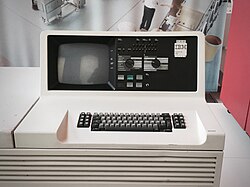
- System/36 (1983): A lower-cost alternative to System/38, it used the System Support Program (SSP) and focused on ease of use for small businesses. It lacked full object-orientation but was compatible with earlier systems like System/34. By 1990, it had ~300,000 installations.
These systems competed internally, prompting IBM to unify them.
The AS/400 Era (1988–2000)
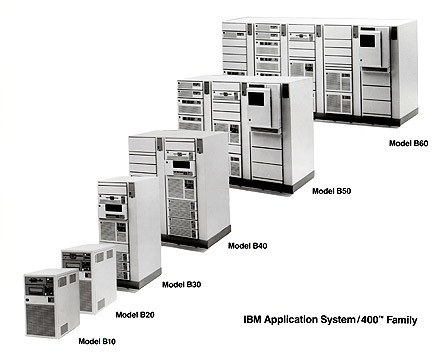
- Launched in 1988 as the Application System/400 (AS/400), it merged System/38’s advanced features with System/36 compatibility under OS/400. Developed via the “Silverlake” project after the failed “Fort Knox,” it emphasized five principles: technology independence, integration, object-based design, single-level store, and hardware integration. By 1997, 500,000 units shipped, generating billions in revenue.
Transition to Power Systems (2000–Present)
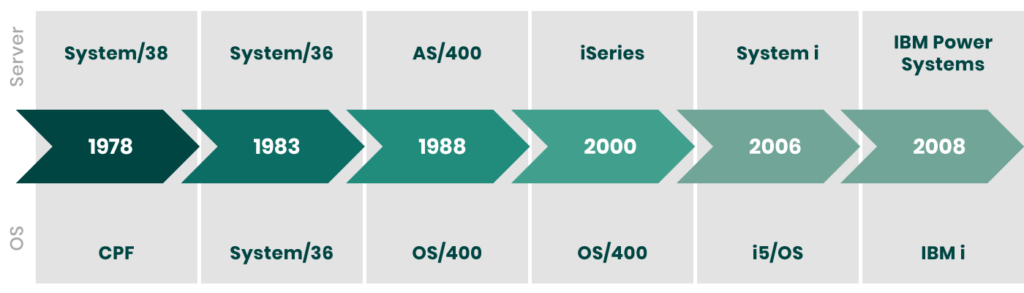
- eServer iSeries (2000): Rebranded for e-business, adopting POWER4 processors.
- eServer i5 (2004): With POWER5 and i5/OS.
- System i (2006): Focused on SMBs as a Windows alternative.
- IBM Power Systems with IBM i (2008): Merged with System p, decoupling OS from hardware; OS renamed IBM i. This shift emphasized virtualization and open-source support.
As of 2025, IBM i runs on POWER11 hardware, supporting hybrid cloud via IBM Power Virtual Server.
Renaming History of the IBM i OS
The OS has undergone several renamings to reflect hardware evolutions and marketing strategies:
- OS/400 (1988–2004): Original name for AS/400, emphasizing integration and reliability.
- i5/OS (2004–2008): Renamed with POWER5 hardware, highlighting “i5” branding for innovation.
- IBM i (2008–Present): Final rename during the Power Systems merger, simplifying to focus on the OS independently of hardware. This decoupled the name from specific models, aiding cloud adoption.
Renaming often caused confusion, but the core architecture remained consistent.
Version History and Key Features Added
IBM i versions follow a VxRy format initially, shifting to simpler numbering with Technology Refreshes (TRs) for modular updates. Here’s a chronological overview:
- V1R1 to V3R2 (1988–1995): Introduced OS/400 basics, TIMI, integrated Db2, RPG/400, and TCP/IP. V3R1 (1994) added client-server support.
- V3R6 to V4R5 (1995–2000): CISC-to-RISC transition; V4R1 (1996) added Java, HTTP server; V4R4 (1999) introduced PASE for AIX compatibility.
- V5R1 to V5R4 (2001–2005): As iSeries; V5R1 (2001) added LPAR virtualization; V5R3 (2004) introduced i5/OS with POWER5, WebSphere integration.
- V6R1 (2008): First as IBM i; added TRs, PowerHA for high availability, BladeCenter support.
- 7.1 (2010): Enhanced virtualization, live partition mobility, SSD support; TRs for ongoing updates.
- 7.2 (2014): JSON/XML support, mobile access, improved security auditing.
- 7.3 (2016): Temporal tables in Db2, stronger encryption, OpenSSL updates.
- 7.4 (2019): AI toolkit integration, SysML support, NVMe storage.
- 7.5 (2022): DevOps tools (Git, Jenkins), cloud integration, TLS 1.3, intrusion detection.
- 7.6 (2025): Released April 18, 2025; focuses on securability, compliance, Db2 enhancements (e.g., SQL functions, AI-assisted queries), DevOps integration, open-source support (Python/Ruby updates), multi-factor authentication (MFA), and Fibre Channel multipath improvements. TR1 (October 2025) adds database performance boosts and security features.
Support for 7.4 ends in 2025; 7.5 extends to ~2030.
Current Status and Future
As of December 2025, IBM i 7.6 powers mission-critical applications in finance, manufacturing, and healthcare, with trends toward AI, cloud, and cybersecurity. Its evolution ensures relevance in hybrid environments.
- IBM i – Wikipedia – Overview of history, architecture, and versions.
- IBM i History and Timeline | Fortra – Timeline and renamings.
- IBM i: A History in Numbers – Seasoft – Numerical milestones and renamings.
- Journey of the Brawny IBM AS400 iSeries | IntegrativeSystems – Evolution and renamings.
- History of IBM i – Nick Litten – Detailed renaming and evolution.
- IBM Changes Name Back to AS/400 – Renaming context.
- The Wild Evolution of AS/400 to IBM i – CNX Corp – Personal perspective on evolution.
- History – Try-AS/400 – Hardware and OS renaming.
- IBM i 7.6 – Base Enhancements – 7.6 features.
- What You Will Find In IBM i 7.6 TR1 and IBM i 7.5 TR7 – IT Jungle – TR updates.
- What’s new for IBM i 7.6 – Documentation updates.
- IBM i 7.6: Powering the Future of Continuous Innovation – New features in 7.6.
- What You Need to Know: IBM i 7.6 Overview – Release details.
- Version 7.6 announced – RPGPGM.COM – Announcement.
- Announcing IBM i 7.6 and IBM i 7.5 TR6 – Db2 enhancements.
- IBM i 7.6: What’s New in IBM iSecurity – Seasoft – Security features.
- IBM i 7.6 | Everything you need to know – Overview.
- Unpacking IBM i 7.6 and 7.5 TR6 – SQL and authority features.
- IBM i (AS/400) History – The Evolution of Computing – Early history.
- IBM iSeries/AS400 Systems Timeline – Milestones up to 2025.
- IBM i History and Timeline | Fortra – Business focus.
- as-400-history – ACOM Systems – System/38 roots.
- Fifty Years Of Operating IBM Systems – IT Jungle – Development goals.
- What is IBM i? – Modern upgrades.
- History of IBM i – Nick Litten – AS/400 to iSeries.
- IBM AS400 – Historical Journey and Future – 47-year journey.