Hey there! Imagine a computer so powerful it could crack every digital lock on the planet in seconds. That’s the promise (and the threat) of quantum computing. If you use a banking app, send encrypted messages, or browse secure websites, you rely on Elliptic Curve Cryptography (ECC). But there’s a catch: quantum computers are coming, and they have the “skeleton key” to today’s ECC and threatens to break many of these cryptographic systems. This is where Post-Quantum Cryptography (PQC) and the emerging concept of Post-Quantum Elliptic Curve Cryptography (PQ-ECC) come into play. If you haven’t had a chance to check out my Elliptic Curve Cryptography and Quantum Cryptography blog posts, I’d suggest giving it a read first—it’ll really help you get a better grasp of the concept.
Table of Contents
What Is Quantum Cryptography (QKD)?
You hear “quantum cryptography” and might picture a sci-fi movie, but let’s keep it real. Quantum cryptography uses principles from quantum physics to secure data. The most famous example? Quantum Key Distribution (QKD). You send encryption keys using particles like photons, and if anyone snoops, quantum rules make it obvious because observing the particles changes them.
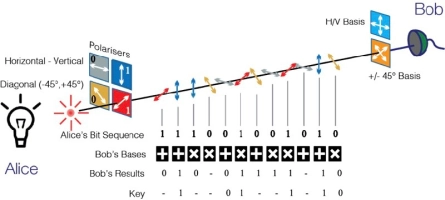
But here’s the twist: When people talk about quantum cryptography in today’s context, they often mean the threats quantum computers pose to our current encryption. A quantum computer runs algorithms like Shor’s, which solves math problems that underpin traditional security super fast. You don’t need a quantum computer to use quantum cryptography, but you do need to defend against one. Think of it as locking your door before a master thief shows up.
Quantum cryptography (specifically Quantum Key Distribution or QKD) uses principles of quantum mechanics to secure communication. It uses the laws of physics—like the behavior of photons—to secure a communication channel. It requires specialized hardware (lasers and fiber optics) to detect if someone is eavesdropping.
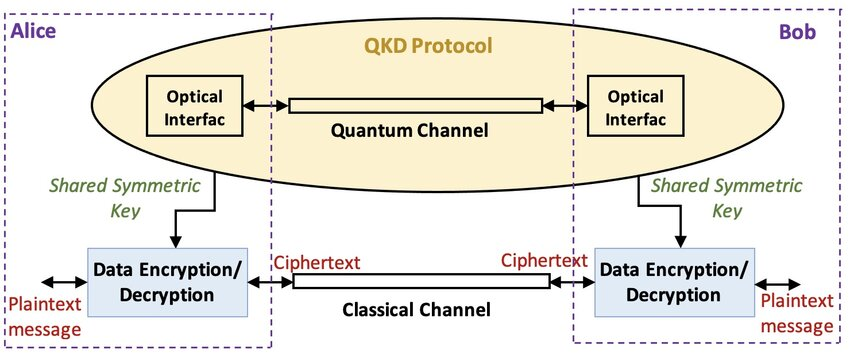
Key Characteristics of Quantum Cryptography
- It relies on quantum states, such as photon polarization.
- Any attempt to eavesdrop changes the quantum state, revealing the attack.
- It focuses mainly on Quantum Key Distribution (QKD).
- Example: BB84 Protocol
- The BB84 protocol allows two parties to exchange encryption keys using quantum particles. If an attacker intercepts the transmission, both parties detect the intrusion immediately.
- Important Clarification: Quantum cryptography:
- Does not replace traditional encryption
- Requires specialized hardware
- Is not widely deployable on the internet
- This limitation makes Post-Quantum Cryptography far more practical.
What Is Post-Quantum Cryptography (PQC)?
Now, shift gears to post-quantum cryptography (PQC). You build PQC algorithms to withstand attacks from quantum computers. Traditional systems like RSA or standard elliptic curve cryptography (ECC) rely on hard math problems—factoring large numbers or discrete logarithms—that quantum machines crack easily with Shor’s algorithm.
In 1994, mathematician Peter Shor developed Shor’s Algorithm. When run on a sufficiently powerful quantum computer, it solves these math problems almost instantly. This creates three massive risks:
- Private Keys Exposed: Hackers could recover your master keys in hours.
- Forgeable Signatures: Digital trust in blockchain and legal documents would vanish.
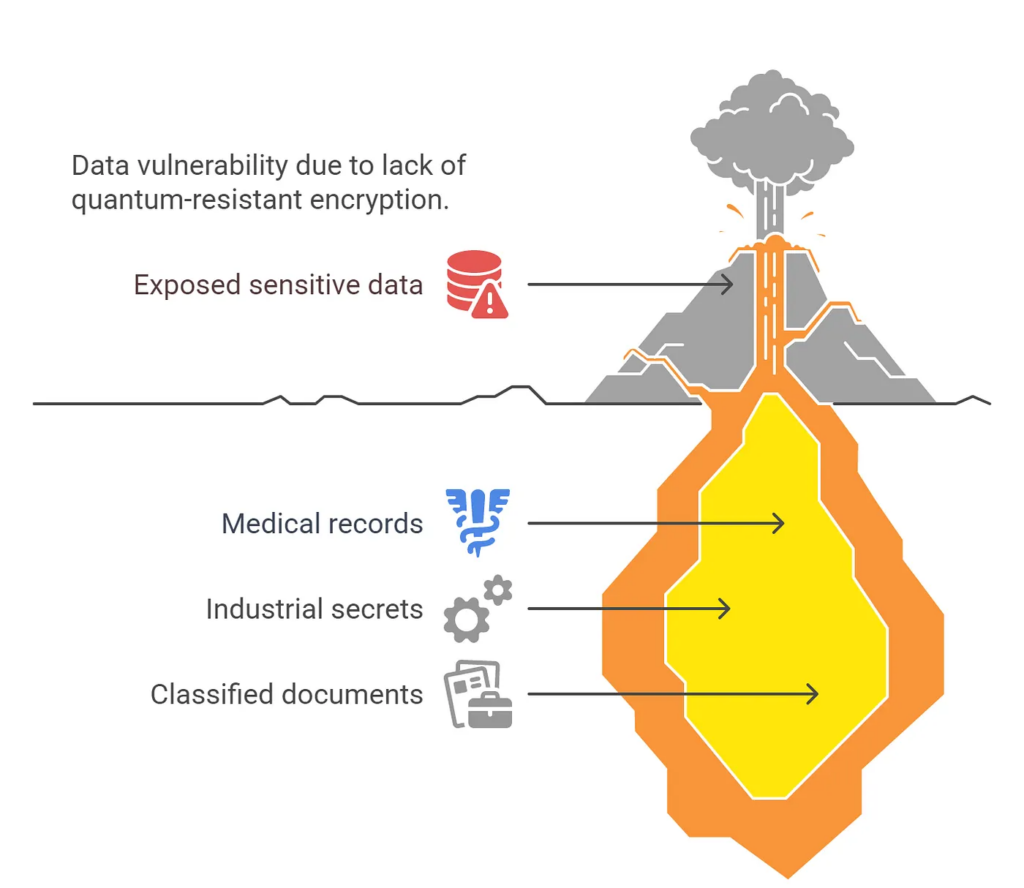
- “Harvest Now, Decrypt Later”: Attackers are currently recording encrypted data, waiting for the day they can use a quantum computer to unlock it.
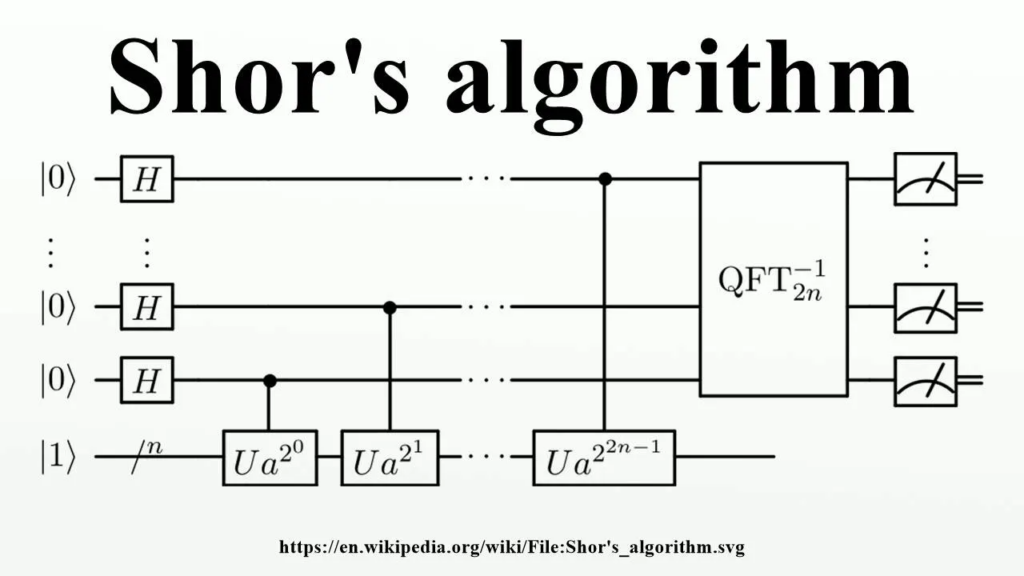
The PQC is purely mathematical. You run these algorithms on your existing laptop or smartphone. PQC flips the script. The goal is to create math problems so complex that even a massive quantum computer cannot solve them efficiently. Organizations like NIST (the U.S. National Institute of Standards and Technology) lead the charge, testing and standardizing these algorithms. As of 2026, NIST has rolled out standards like ML-KEM for key encapsulation, ML-DSA and SLH-DSA for signatures, and HQC as a backup. You adopt PQC to future-proof your data—protecting emails, bank transactions, and more from “harvest now, decrypt later” attacks where hackers store encrypted info today and crack it tomorrow.
Key Goals of PQC
- Resist Shor’s algorithm (which breaks RSA and ECC)
- Resist Grover’s algorithm (which weakens symmetric encryption)
- Run efficiently on classical computers
- Replace today’s public-key cryptography
Why PQC Matters
A future quantum computer could:
- Compromise banking, government, and healthcare systems
- Break HTTPS encryption
- Decrypt stored data retroactively (“harvest now, decrypt later”)
Post-Quantum Cryptography vs. Quantum Cryptography
It is important to distinguish between the two ways we fight quantum threats:
- Quantum Cryptography (QKD): Uses hardware (lasers, fiber optics) and physics. It is unhackable by any computer, now or in the future.
- Post-Quantum Cryptography (PQC): Uses “quantum-resistant” math on your existing laptop. NIST (National Institute of Standards and Technology) is currently standardizing these, such as ML-KEM (Kyber) and ML-DSA (Dilithium).
The key differences between quantum cryptography and post-quantum cryptography are shown in the following table.
| Quantum Cryptography | Post-Quantum Cryptography |
| “Quantum cryptography,” sometimes known as “quantum encryption” or “quantum security,” is the term used to describe the use of quantum physics in the science of cryptography. | A group of techniques known as post-quantum cryptography are usually public-key algorithms and have been developed to resist an attack from a quantum computer. |
| Specialized hardware will be required for implementation. | Most solutions won’t require specialized hardware but rely only on software. |
| Quantum physics says a quantum channel cannot be successfully intercepted without detection. | Algorithms can be examined to determine how reliable they are, but there is no guarantee that someone won’t eventually find a way to defeat them. |
| It only uses optical communication through an optical fiber in open space. | It works with any digital communications media, including optical communications and RF wireless networks. |
| Higher expenses because new communications infrastructure and technology are required. | Solutions for software-based synthesis will be reasonably priced. |
| Although it’s unlikely, it’s feasible that it could be used for digital signatures. | Many versions of the standards are currently being developed for the usage of digital signatures. |
| There are only a few choices. Use should only be made of line-of-sight nodes. | Appropriate for communicating via any mobile device. |
What Is Post-Quantum Elliptic Curve Cryptography (PQ ECC)?
You might wonder: “If ECC is broken by quantum computers, how can there be a Post-Quantum version?” PQ-ECC does not mean “ECC made quantum-safe.” PQ-ECC” doesn’t mean we are just making standard ECC keys bigger. This is a common misconception.
PQ-ECC refers to:
- Replacing traditional ECC with post-quantum algorithms
- Maintaining ECC-like efficiency, small keys, and performance
- Using lattice-based, isogeny-based, or hybrid constructions
- Isogeny-Based Cryptography: Using elliptic curves in a totally different mathematical way that resists Shor’s Algorithm.
- Lattice-Based Replacements: New algorithms that provide ECC-like efficiency (small keys and high speed) using quantum-safe math.
In short: PQ-ECC aims to deliver ECC-level efficiency without ECC’s quantum vulnerability.
Why Do We Need PQ ECC?
Quantum computers loom large, and they target your current security. Shor’s algorithm lets a quantum machine solve the elliptic curve discrete logarithm problem exponentially faster than classical computers. ECC relies on the Elliptic Curve Discrete Logarithm Problem (ECDLP). A sufficiently powerful quantum computer can:
- Solve ECDLP using Shor’s algorithm
- Recover private keys in polynomial time
- Break ECDSA, ECDH, and EdDSA
Real-World Impact
- TLS certificates become insecure
- Digital signatures lose trust
- Blockchain systems face existential risk
Why Not Just Increase Key Sizes?
- Key size increases do not help against quantum attacks.
- You must change the mathematical foundation, not just the parameters.
PQ ECC lets you upgrade without starting from scratch. It offers smaller keys than other PQC options like lattice-based systems, saving bandwidth and power for devices like smartphones or IoT gadgets. Governments and companies push for it now; for instance, the NSA recommends quantum-resistant crypto by 2030. Ignore it, and you risk massive data breaches when quantum tech matures.
How Does PQ ECC Work?
You start with elliptic curves over finite fields—think of them as points on a graph with special addition rules. Traditional ECC uses the equation and focuses on adding points on a single curve.
PQ-ECC (Isogeny-based) flips the script. Instead of looking at points on one curve, it looks at the maps (isogenies) between many different curves. Imagine a massive graph where every node is a different elliptic curve. To find the secret path between “Curve A” and “Curve B” is a problem that remains “insanely hard” for both classical and quantum computers. Researchers call this isogeny-based cryptography. It keeps ECC’s perks like tiny keys and speed while dodging quantum pitfalls. You see PQ ECC as a bridge: It builds on familiar elliptic curves but adds quantum armor.
Parties agree on a starting supersingular elliptic curve (a type that’s extra secure for this). Each side picks a secret “walk” along isogeny graphs—networks of curves connected by these maps. You compute a shared secret by combining your private walks with the other’s public info. Attacks fail because reversing these walks (finding the isogeny path) is insanely hard, even for quantum computers.
Unlike broken schemes like SIDH (cracked in 2022), modern PQ ECC uses refined versions. You deploy it in hybrid modes, blending with classical ECC for safety during transitions.
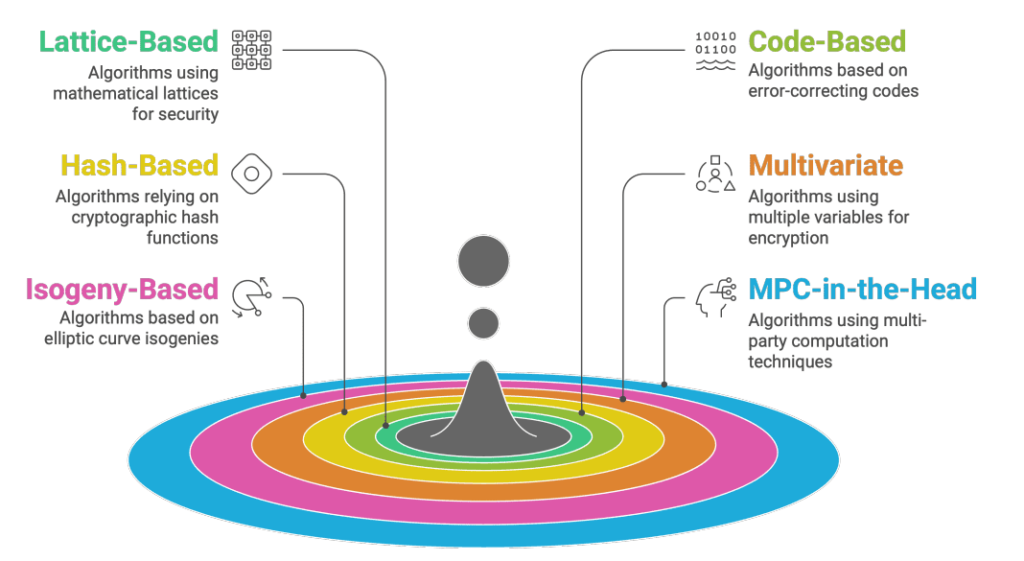
Post-quantum cryptography replaces number-theoretic problems with quantum-resistant problems.
Major PQC Families
- Lattice-based cryptography
- Code-based cryptography
- Hash-based signatures
- Multivariate polynomial cryptography
- Isogeny-based cryptography (ECC-inspired)
Algorithms Related to PQ-ECC
You find several standout algorithms in PQ ECC.
- CSIDH (Commutative Supersingular Isogeny Diffie-Hellman): You use this for key exchange. It relies on class group actions on supersingular curves, making it commutative (order doesn’t matter). CSIDH shines with small keys and decent speed.
- SQISign: You apply this for digital signatures. It computes short isogeny representations for verification, offering quantum-resistant signing with compact sizes.
- SEA (Supersingular Elliptic Curve Isogeny): An older building block, but you see it in research for encryption primitives.
The NIST (National Institute of Standards and Technology) has been leading a global race to standardize these algorithms.
| Category | Algorithm | Status | Examples | Why Use It? |
|---|---|---|---|---|
| Lattice-Based | ML-KEM (Kyber) | Standardized (2024) | CRYSTALS-Kyber (Key Encapsulation) | Super fast; small keys; the “gold standard” replacement for ECC. |
| Lattice-Based | ML-DSA (Dilithium) | Standardized (2024) | CRYSTALS-Dilithium (Digital Signatures) Falcon (Compact signatures) | The primary choice for digital signatures. |
| Isogeny-Based | CSIDH / SQISign | Research Phase | Offers the smallest keys; high potential for mobile/IoT. | |
| Isogeny-Based | SIKE | Deprecated | SIKE (Supersingular Isogeny Key Encapsulation) | Cracked in 2022 by a traditional PC; serves as a cautionary tale. |
⚠️ Note: NIST later deprecated SIKE due to classical attacks, but it remains important academically.
How Key Exchange Happens in PQ ECC
Key exchange in PQ-ECC mimics the classic Diffie-Hellman flow but uses these complex “secret paths” (with isogenies):
- Setup: Alice and Bob agree on a starting “supersingular” elliptic curve and parameters like prime .
- Private Keys: Alice picks a secret “walk” (a sequence of isogenies); Bob picks his own secret walk .
- Public Keys: Alice compute an from to a new curve sharing and some points. Bob do the same for .
- The Shared Secret: Alice applies her secret walk to Bob’s curve E_AB, and Bob applies his walk to Alice’s curve E_AB. They both land on the exact same final curve, which they hash into a secret key.

Quantum computers struggle because claw-finding algorithms don’t efficiently reverse isogeny paths. You get forward secrecy too—past sessions stay safe even if keys leak later.
The Mathematics Behind PQ ECC
Let’s geek out a bit, but I’ll keep it approachable. An elliptic curve over a field looks like . Points on form a group under “addition.”
An isogeny is a rational map sending the identity to identity, with . The kernel (points mapping to zero) defines it.
In supersingular curves (where #, isogenies of degree l form graphs. The hard problem? Given and , find the isogeny connecting them. That’s like a quantum-resistant discrete log.
For math fans: Use Vélu’s formulas to compute isogenies from kernels. Say kernel of order . Then the codomain curve’s coefficients derive from sums over G’s points.
| KEM | Public Key size (bytes) | Ciphertext (bytes) | Secret size (bytes) | KeyGen (op/sec) | Encaps (op/sec) | Decaps (op/sec) | NIST level |
|---|---|---|---|---|---|---|---|
| HRSS-SXY | 1138 | 1138 | 32 | 3952.3 | 76034.7 | 21905.8 | 1 |
| SIKE/p434 | 330 | 346 | 16 | 367.1 | 228.0 | 209.3 | 1 |
Real-World Examples of PQ ECC
| Example | Features/Benifits |
|---|---|
| TLS Hybrid Key Exchange | Modern TLS implementations combine: ECC (temporary) Kyber (post-quantum) This approach provides: Backward compatibility Quantum-safe protection |
| Cloud Providers | Google tests Kyber + ECDHE Cloudflare supports post-quantum TLS AWS experiments with PQC libraries |
| Browsers | Google Chrome and Cloudflare are already testing “Hybrid” key exchanges, combining traditional ECC with Kyber. |
| Messaging | Apps like iMessage and Signal have begun integrating post-quantum protections. |
| Blockchain | Ethereum is exploring “SQISign” to keep wallet signatures small and quantum-resistant for mobile users. |
| Enterprise Systems | VPNs Secure email Hardware Security Modules (HSMs) |
Even cars: Autonomous vehicles share data via PQ ECC, resisting quantum hacks on traffic systems.
Standardization Efforts for PQ ECC
NIST drives PQC standardization. NIST PQC Competition Results as below.
Key Exchange
- CRYSTALS-Kyber
Digital Signatures
- CRYSTALS-Dilithium
- Falcon
- SPHINCS+
These algorithms will replace ECC and RSA over time.
By 2026, they’ve finalized ML-KEM, ML-DSA, SLH-DSA, FN-DSA, and HQC (selected in 2025 as a code-based backup). Isogeny-based? Not yet—they’re in research mode after SIDH’s fall.
You see progress in EU projects and academic conferences like PQCrypto. Experts predict isogeny standards by 2030 if attacks hold off. For now, hybrid setups (PQ ECC + NIST algos) rule. Check NIST’s site for updates—they’re evaluating more signatures.
Migration Strategy: From ECC to PQ-ECC
Recommended Approach
- Start with hybrid cryptography
- Upgrade TLS libraries
- Inventory cryptographic dependencies
- Plan long-term PQC adoption
You must prepare today, because attackers can store encrypted data now and decrypt it later.
Wrapping Up: Secure Your Future with PQ ECC
The “Quantum Apocalypse” isn’t here yet, but the transition has officially begun. Whether it is through isogeny-based maps or high-dimensional lattices, PQ-ECC represents the cutting edge of geometry and algebra.
Organizations that adopt PQC early will protect their long-term data and stay ahead of the next generation of threats. The math is ready—is your infrastructure? Got questions? Drop them in the comments—let’s keep the conversation going!