The IBM AS/400, formally known as the Application System/400, represents a pivotal milestone in the evolution of midrange computing systems. Launched by IBM in June 1988 and made available in August of that year, this platform was engineered to consolidate and enhance the capabilities of its predecessors, including the System/36 and System/38, while introducing groundbreaking features that prioritized reliability, scalability, and user accessibility.
Targeted at small to medium-sized enterprises as well as larger organizations, the AS/400 integrated hardware, an advanced operating system, and a built-in relational database into a cohesive ecosystem, enabling efficient management of mission-critical applications across diverse industries such as banking, manufacturing, retail, and healthcare. Its design philosophy emphasized backward compatibility, allowing seamless transitions from older systems without necessitating extensive rewrites of software, which contributed to its rapid adoption and enduring popularity.
By the early 1990s, the AS/400 had generated billions in revenue for IBM and boasted hundreds of thousands of installations worldwide, underscoring its commercial success. Today, its lineage persists through the IBM i operating system running on IBM Power Systems, continuing to support modern workloads with enhancements in AI, cloud integration, and security as of 2025.
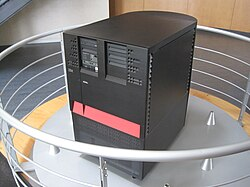
Table of Contents
History and Development
The genesis of the AS/400 can be traced back to IBM’s efforts in the early 1980s to unify its disparate midrange computer offerings, which were plagued by incompatibility and internal competition. The System/38, introduced in 1979, featured an innovative object-based architecture and integrated database, while the System/36, launched in 1983, catered to smaller businesses with simpler programming models.
However, these systems vied against each other and external competitors like DEC’s VAX, prompting IBM to initiate the “Fort Knox” project in 1982. This ambitious endeavor aimed to merge multiple lines—including the System/36, System/38, IBM 8100, Series/1, and IBM 4300—into a single architecture based on the IBM 801 RISC processor. Despite significant investment, Fort Knox faced insurmountable technical challenges, escalating costs, and delays, leading to its cancellation in 1985 after narrowing its scope to exclude several systems.
In response, a dedicated team at IBM’s Rochester, Minnesota facility—led by figures like Frank Soltis, the chief architect—launched the “Silverlake” project in December 1985 as a skunkworks initiative. Drawing heavily from the System/38’s technology, Silverlake focused on creating a competitive midrange system that could replace both the System/36 and System/38 while ensuring compatibility.
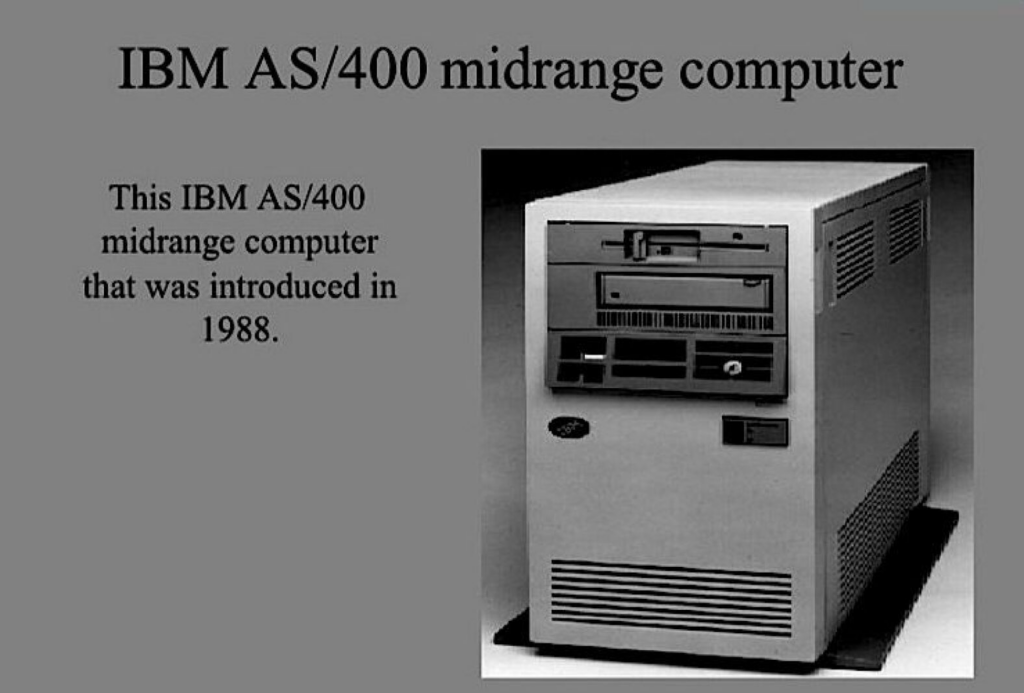
The project progressed rapidly, culminating in the AS/400’s announcement on June 21, 1988. At launch, it supported over 1,000 software packages, leveraging powerful 48-bit CISC processors (IMPI) and a token ring network capable of 16 Mbps speeds, enabling up to 45,000 transactions per hour—a dramatic improvement over prior systems.
The platform’s early success was evident: by 1990, it had amassed $14 billion in revenue with 111,000 installations, expanding to 250,000 by 1994 and 500,000 shipped units by 1997. This growth was fueled by its ability to digitize operations for non-technical users, such as in law firms, insurance companies, and government agencies, where a single administrator could manage the entire system.
In-Depth Architecture and Key Features
The AS/400’s architecture was groundbreaking, built on five foundational principles: technology independence, software integration, object-based design, single-level store virtual memory, and hardware integration. Central to this was the Technology Independent Machine Interface (TIMI), a layer that abstracted hardware specifics, allowing applications to run unmodified across evolving processor generations by translating a platform-independent instruction set into native machine code. This ahead-of-time compilation ensured unparalleled backward compatibility—applications written in the late 1980s can still execute on contemporary IBM i systems without recompilation.
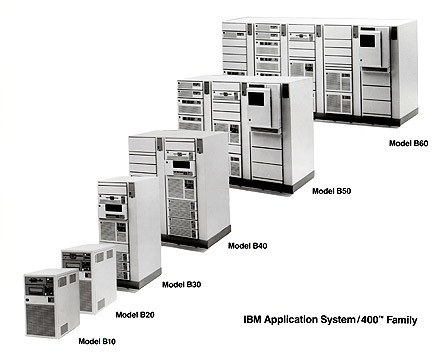
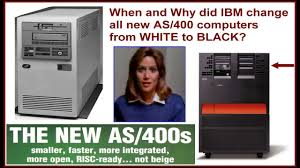
Hardware initially featured 48-bit Complex Instruction Set Computing (CISC) processors under the Internal Micro-Programmed Interface (IMPI), operating at speeds exceeding 22 MHz. In 1995, IBM transitioned to 64-bit PowerPC-derived CPUs with V3R6, rewriting the System Licensed Internal Code (SLIC) below TIMI to accommodate the Reduced Instruction Set Computing (RISC) architecture. Subsequent upgrades included POWER4 (2001), POWER5 (2004), POWER6 (2007), POWER7 (2010), POWER8 (2014), POWER9 (2017), and POWER10 (2020), with previews of POWER11 integration by 2025. Models varied from entry-level B-series (Commercial Processing Workload, CPW, ratings of 2.9-20) to high-end configurations like the Model 840 (up to 20,200 CPW), supporting logical partitioning (LPAR) for virtualizing multiple operating systems, including AIX, Linux, and Windows, alongside the native OS.
The object-based design treated all system resources—files, programs, devices—as objects with encapsulated attributes and methods, enhancing security through authority-based access controls. The single-level store unified memory and disk into a 64-bit virtual address space (up to 2^64 bytes), simplifying data management and boosting performance by eliminating traditional paging distinctions. Integrated features included the relational database Db2 for i (evolved from System/38’s non-relational roots), multi-user support via block-oriented 5250 terminals, and robust networking with TCP/IP and Systems Network Architecture (SNA). Security was fortified with five user classes (from Workstation User to Security Officer) and levels ranging from 10 (minimal) to 50 (TCSEC C2 compliance), with QSECOFR serving as the root-equivalent profile. Storage management utilized auxiliary storage pools (ASPs) to organize disks and mitigate failure impacts, akin to volume groups.
Operating System: From OS/400 to IBM i
The AS/400’s operating system, OS/400, was an object-oriented, integrated environment that embedded database, security, networking, and middleware functionalities directly into the kernel. It featured a user-friendly menu-driven interface for novices, a powerful command-line for experts, and support for programming languages like RPG (Report Program Generator), COBOL, C, C++, Java, EGL, REXX, and later open-source options such as Python, PHP, Node.js, and Ruby via the Portable Application Solutions Environment (PASE). The Integrated Language Environment (ILE) allowed binding of modules from compatible languages into single executables, while PASE, introduced in V4R3 (1998), enabled AIX binary compatibility and compilation of open-source software like GCC.
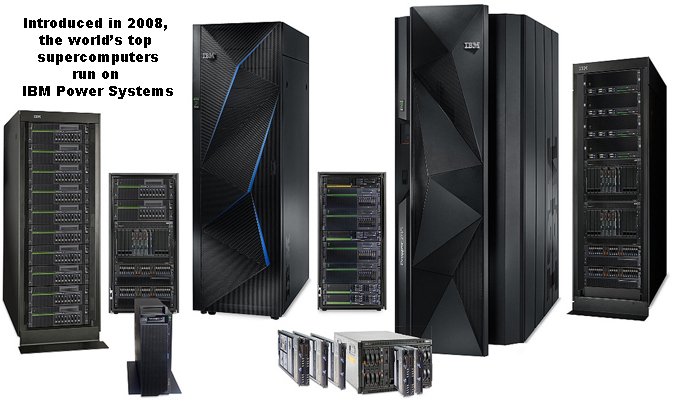
OS/400 was rebranded to i5/OS in 2004 to align with POWER5 hardware, and then to IBM i in 2008 during the merger with System p into Power Systems. Versioning evolved from VxRyMz (e.g., V2R1M1) to simpler formats like 6.1, with Technology Refreshes (TRs) introduced in 7.1 for modular updates via Program Temporary Fixes (PTFs). As of 2025, the latest is IBM i 7.6 (released April 18, 2025), with TR1 available November 21, 2025, incorporating enhancements in AI-assisted engineering, multi-factor authentication (MFA), and modernization tools. IBM i 7.5 TR7, also from November 2025, adds database improvements, security updates like TLS 1.3, intrusion detection, and integration with NVMe storage and cloud solutions. Support for older versions like 7.4 ends in 2025, urging upgrades. Development tools include IBM Rational Developer for i (Eclipse-based) and IBM Navigator for i for web management.
Evolution, Rebrandings, and Modernization
The AS/400’s evolution reflected IBM’s adaptation to market shifts:
- 1994: AS/400 Advanced Series – Introduced faster processors, enhanced flexibility, and improved I/O capabilities.
- 1997: AS/400e – Focused on e-business with web server integration and Java support.
- 2000: eServer iSeries – Rebranded for internet-centric computing, adopting POWER4 processors.
- 2004: eServer i5 – Integrated POWER5 and i5/OS, emphasizing virtualization.
- 2006: System i – Positioned as an alternative to Windows for SMBs, with enhanced open-source support.
- 2008: IBM Power Systems with IBM i – Unified with System p, supporting POWER6 and beyond.
Post-2008 releases included IBM i 7.1 (2010) with TRs for modular updates, 7.2 (2014) adding JSON and mobile support, 7.3 (2016) enhancing security, 7.4 (2019) with AI integrations, and 7.5 (2022) focusing on DevOps and cloud. In 2025, trends emphasize AI, modernization (e.g., containerization via Red Hat OpenShift), and cybersecurity, with Power 11 hardware promising enhanced performance for IBM i workloads. Modernization efforts include porting open-source databases like MySQL and PostgreSQL to PASE, and tools for RPM/YUM package management.
Market Impact, Use Cases, and Legacy
The AS/400 democratized advanced computing by enabling rapid network setups and operational digitization, reducing the need for large IT teams. It supported over 18,000 applications at its peak, with performance metrics like CPW ratings scaling to meet enterprise demands. During IBM’s 1993 financial crisis, the AS/400’s reliability proved invaluable, and notably, Microsoft utilized it internally until 1999. Compared to competitors like DEC VAX or HP 3000, the AS/400 excelled in integration and longevity, often outlasting them due to its fewer failure points and hardware abstraction.
Use cases spanned ERP systems (e.g., SAP R/3 ports), financial transactions, supply chain management, and custom applications in RPG/COBOL. Its legacy influenced modern hybrid cloud environments, with IBM i now deployable on-premises, private clouds, or public clouds via IBM Power Virtual Server. Surveys in 2025 indicate continued investment, with users upgrading for AI and resiliency features.
Current Status and Future Prospects
While original AS/400 hardware was phased out by 2013, IBM i endures as a proprietary OS for IBM Power Systems, powering minicomputers to enterprise servers. As of December 2025, support for IBM i 7.5 extends to at least 2030, with 7.6 introducing built-in MFA and AI tools. Challenges include modernization pressures and skill gaps, but opportunities in AI integration and Power 11 hardware position it for future relevance. IBM’s 2025 branding refresh, including new interfaces, aims to attract younger developers.
Final Thoughts
The IBM AS/400’s journey from a 1988 midrange powerhouse to the modern IBM i exemplifies IBM’s commitment to innovation and longevity. Its architecture, features, and evolutions have left an indelible mark on computing, proving that well-designed systems can endure for generations. For businesses still relying on this technology, it offers a blend of reliability and adaptability that few platforms can match.
References for the Article: The IBM AS/400 – A Comprehensive Legacy of Innovation in Midrange Computing
Below is a compiled list of the primary reference sources used or referenced in the detailed article. These include official IBM pages, Wikipedia entries (for historical overviews), industry publications, and announcements. Each includes a brief description of its relevance.
- https://en.wikipedia.org/wiki/IBM_AS/400 Comprehensive Wikipedia article on the IBM AS/400, covering announcement (June 21, 1988), history, architecture (including TIMI, single-level store), processor evolution, rebrandings, and legacy.
- https://www.ibm.com/history/as-400 Official IBM history page detailing the AS/400’s development, connectivity features, hardware innovations (e.g., megabit memory chips), and its impact on midrange computing for small businesses.
- https://en.wikipedia.org/wiki/IBM_i Wikipedia entry on IBM i (evolution of OS/400), including Fort Knox project failure, Silverlake origins, rebrandings (i5/OS, IBM i), and technical details like SLIC implementation.
- https://wiki.midrange.com/index.php/History_of_OS/400 Midrange community wiki on OS/400 history, with release timelines, withdrawals, and references to IBM announcements.
- https://wiki.midrange.com/index.php/IBM_i Overview of IBM i features, naming history (from OS/400), and integrations like PASE.
- https://wiki.midrange.com/index.php/AS/400 Concise history of the AS/400 as successor to System/38, hardware shifts (CISC to PowerPC), and market impact.
- https://www.ibm.com/history (related sections) and community discussions** Insights into market impact, digitization for non-technical users, and comparisons to competitors.
- Frank Soltis references (e.g., interviews and books like “Inside the AS/400”) Architectural principles (technology independence, object-based design) attributed to chief architect Frank Soltis; see https://en.wikipedia.org/wiki/Frank_Soltis and related IT Jungle interviews.
- https://wiki.midrange.com/index.php/Silverlake and book “The Silverlake Project” by Roy A. Bauer et al.** Detailed history of the Silverlake project (post-Fort Knox), rapid development, and success leading to AS/400 launch.
- https://www.ibm.com/support/pages/ibm-i-technology-updates Official IBM page for ongoing IBM i enhancements and Technology Refreshes.
- IBM Announcement Letters and Blogs (e.g., Steve Will’s announcements) Details on IBM i 7.6 release (announced April 2025, available April 18, 2025), features like built-in MFA, database improvements, and support timelines.
- https://www.ibm.com/support/pages/ibm-i-76-base-enhancements Specific enhancements in IBM i 7.6, including security, RPG updates, and hardware support (Power10/Power11).
- IT Jungle articles (e.g., “Plotting Out Power Systems And IBM i To 2040 And Beyond”) Roadmap discussions, release cadences, and future prospects (e.g., IBM i Next in ~2028).
- https://www.ibm.com/support/pages/release-life-cycle Official IBM i release support lifecycle, including end-of-support dates.
- Various IBM Newsroom and Roadmap Previews 2025 trends: Power11 hardware, AI integrations, cloud (Power Virtual Server), and modernization tools.
- https://en.wikipedia.org/wiki/IBM_Power_microprocessors Processor evolution from IMPI CISC to POWER series.