While quantum systems promise breakthroughs in processing power, they also pose a fundamental risk to the classical encryption—such as RSA and Elliptic Curve Cryptography (ECC)—that secures our global financial, healthcare, and government data. To meet this challenge, IBM has engineered the IBM Power11, the latest generation of IBM’s Power architecture released in 2025, adopts a “secure by design” approach that embeds security features holistically across its silicon, firmware, and software layers to create a resilient, end-to-end chain of trust for enterprise workloads in hybrid cloud environments. This integration ensures protection against evolving threats like ransomware, quantum attacks, and firmware manipulation, while enabling compliance with standards such as NIST and FIPS.
Table of Contents
Here is how the architecture integrates security across the three primary layers:
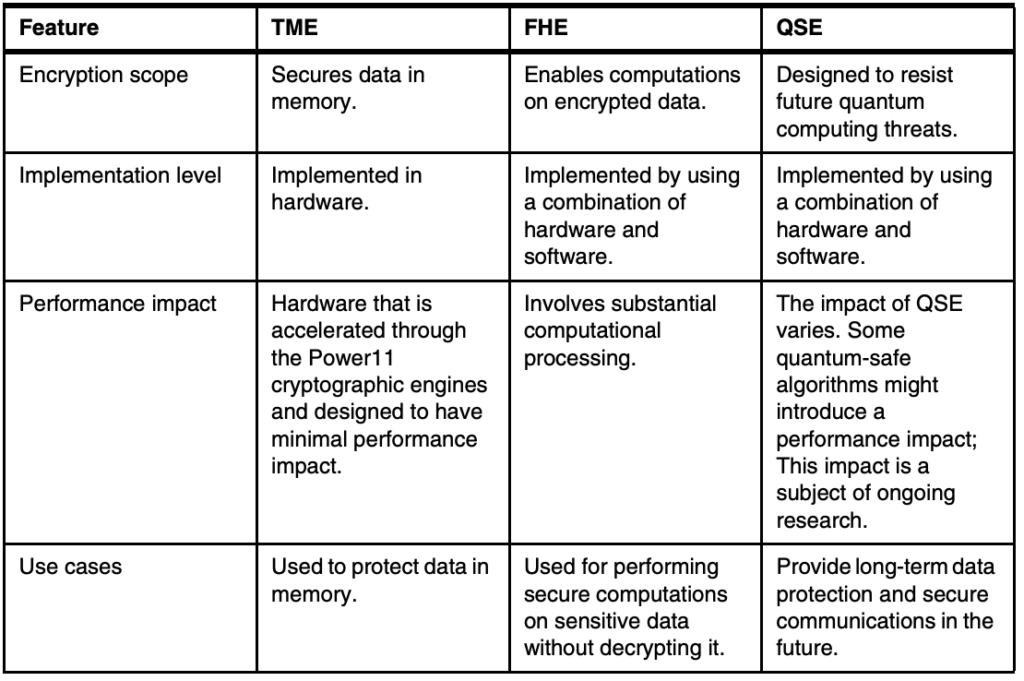
Quantum-Safe Encryption
Quantum computers have the potential to break current cryptographic algorithms. QSE employs cryptographic algorithms believed to be resistant to quantum attacks, such as lattice-based, hash-based, and multivariate quadratic equation-based cryptography. However, many quantum-safe algorithms are still in testing and standardization to ensure robust security against future quantum advancements. QSE is typically used to secure long-term data, sensitive communications, and critical infrastructure.
The Technology: Post-Quantum Cryptography (PQC)
Quantum-safe security refers to cryptographic algorithms specifically designed to resist attacks from quantum computers, such as those utilizing Shor’s or Grover’s algorithms. IBM Power11 leverages Lattice-based cryptography, a branch of PQC that relies on the mathematical hardness of high-dimensional lattices, which are believed to be resistant to both classical and quantum attacks.
The Power11 platform emphasizes comprehensive security throughout its design and offers
multiple encryption options. Key options include Transparent Memory Encryption (TME), Fully
Homomorphic Encryption (FHE), and QSE.
Silicon Layer – Hardware/Processor Level
At the core of Power11’s security is the processor itself, which incorporates hardware-accelerated cryptographic capabilities and memory protections to establish a root of trust from the outset. Power11 processors feature a Hardware-Rooted Trust Chain anchored by immutable Secure ROM (SROM) and One-Time Programmable ROM (OTPROM). These components store cryptographic public key hashes fused into the chip during manufacturing, ensuring that the system’s “root of trust” is physically tamper-proof.
- Integrated On-Chip Cryptographic Accelerators Each Power11 core contains multiple dedicated cryptographic engines (including v2 Vector Scalar Matrix engines) that accelerate algorithms such as AES, SHA-2, SHA-3, and NIST-approved post-quantum standards (e.g., ML-KEM and ML-DSA). These engines enable high-performance, low-overhead encryption for data in transit and at rest — including operations like AIX Logical Volume Encryption — with effectively zero performance penalty.
- Pervasive Memory Encryption Power11 provides hardware-level encryption of all DRAM contents as data moves between the processor and DDR5 memory. Encryption is completely transparent, requires no software intervention, and operates seamlessly across virtual machines (VMs) and containers. Keys are generated on-chip and never leave the processor, delivering strong protection against physical attacks such as cold-boot attacks, memory probes, or unauthorized access even when an attacker has physical possession of the system.
- Hardware Memory Tagging (HMT) and Memory Protection Memory blocks are tagged at the hardware level, and every buffer access is validated against its corresponding tag. This critical defense mechanism catches invalid memory accesses and blocks many classes of software attacks, including buffer overflows, use-after-free vulnerabilities, and certain side-channel exploits.
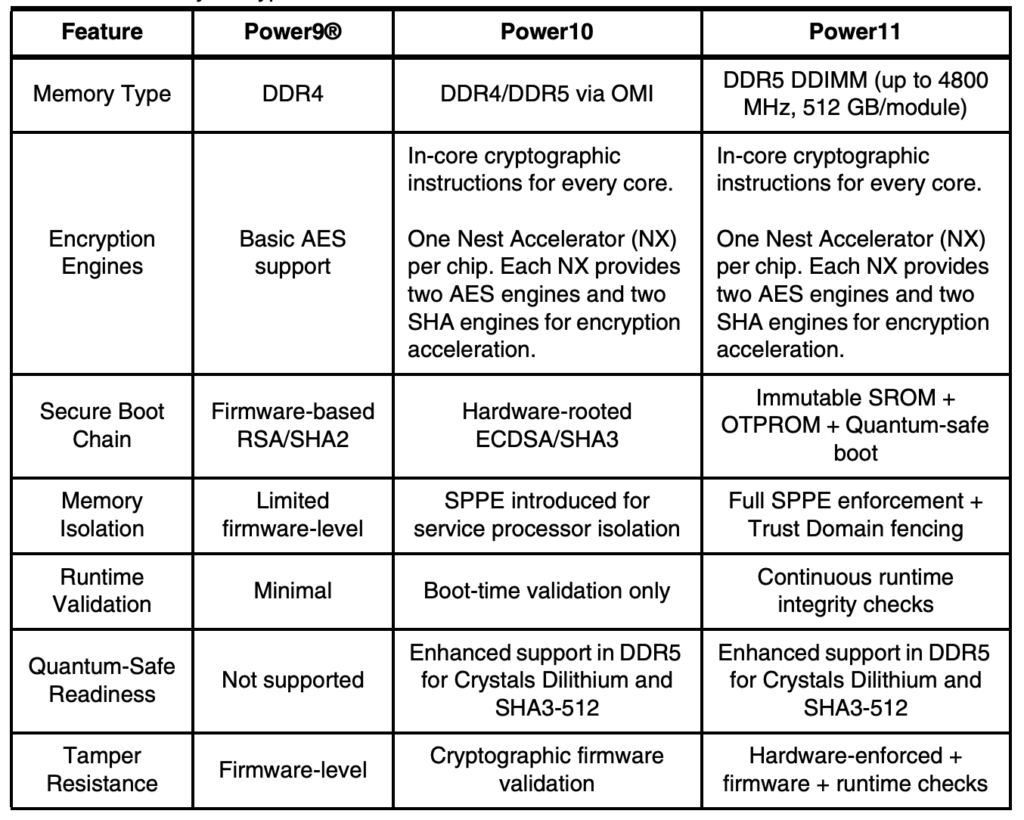
These silicon-level features create a comprehensive, hardware-anchored security foundation. Security verification and protection begin at power-on and propagate upward through all layers, making it significantly more difficult for attackers to compromise the system at lower levels while delivering pervasive, high-performance data protection that is both quantum-resistant and resilient to physical and software-based threats.
The Firmware and Boot Layer
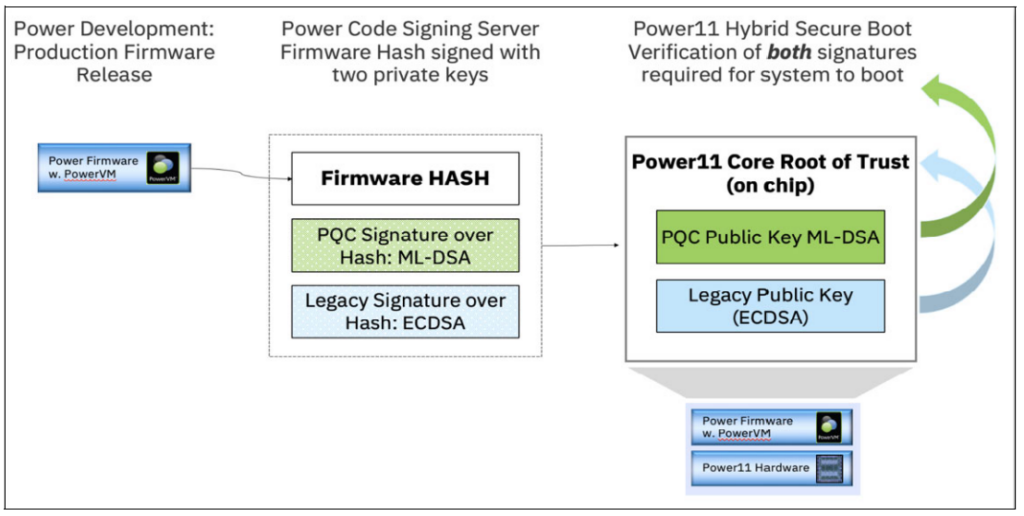
Power11’s firmware acts as a bridge between silicon and software, enforcing integrity checks and secure boot processes to prevent tampering. Power11 introduces a robust Dual-Signature Secure Boot mechanism.
- Trusted Boot & Secure Boot Chain with Quantum-Safe Verification Power11 implements a hardware-enforced secure boot chain that cryptographically verifies firmware and boot components before execution, preventing tampered code from running. Unlike previous generations that relied on classical RSA signatures, Power11 uses NIST-approved quantum-safe algorithms (such as CRYSTALS-Dilithium / ML-DSA) for quantum-safe secure boot, ensuring the very first piece of code is validated against future quantum threats and establishing an immutable hardware root of trust that anchors all subsequent layers.
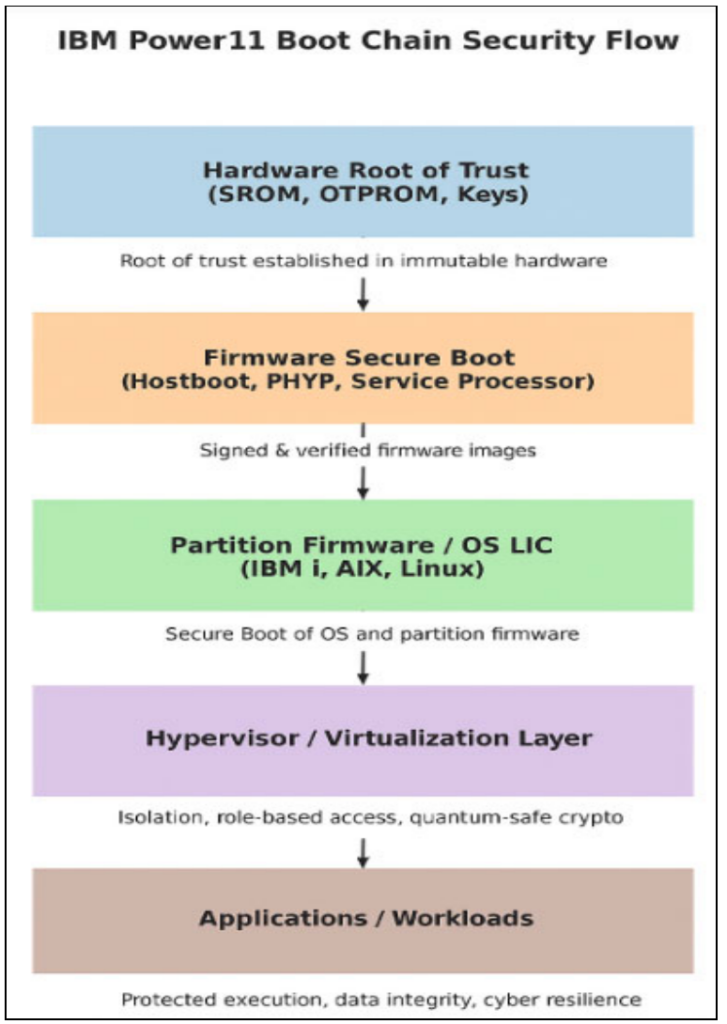
- Firmware Integrity Checks and Hardening: System-wide monitoring detects and mitigates firmware manipulation, integrated with silicon crypto engines for real-time validation. Complementing Secure Boot are firmware integrity checks, which continuously monitor the system for unauthorized changes to firmware binaries and configuration data. If tampering is detected, such as the presence of a rootkit or bootkit, the system automatically halts the boot process and enters a secure recovery mode. This proactive defense mechanism helps prevent persistent threats from compromising the system at its lowest levels.
- Live Firmware Updates: To maintain security posture without sacrificing availability, Power11 supports live firmware updates, allowing administrators to apply critical patches and feature enhancements without requiring system downtime. This capability is essential for enterprise environments where uptime is critical, and it helps reduce the window of exposure to known vulnerabilities. Firmware updates are cryptographically signed and validated before deployment, ensuring hat only trusted updates are applied. Combined, these features deliver a resilient and secure boot infrastructure that aligns with modern enterprise security and compliance requirements.
The Virtualization and Workload Layer
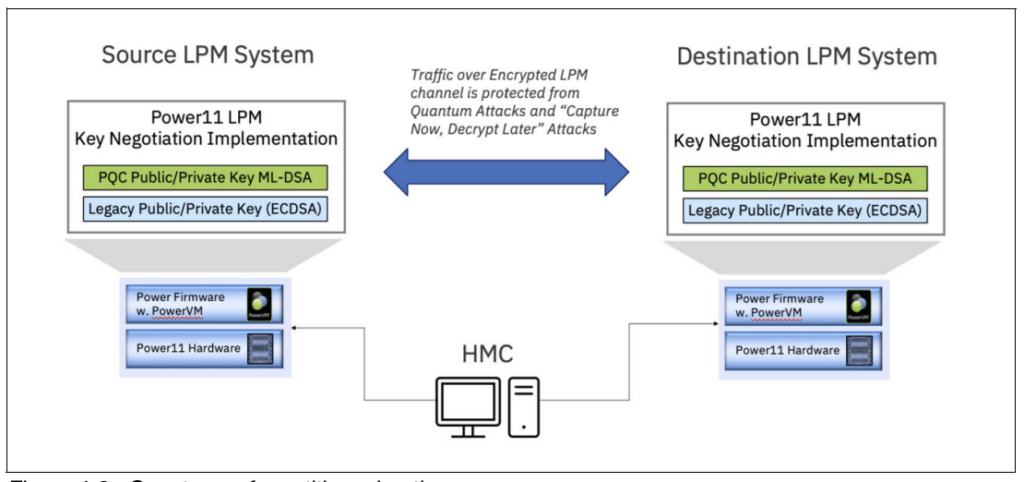
Workload mobility is essential for the hybrid cloud, and Power11 ensures it remains secure through Quantum-Safe Live Partition Mobility (LPM). When active partitions are migrated between servers, Power11 uses a hybrid key establishment strategy. By employing both classical and quantum-safe key pairs to negotiate session keys, the system ensures that even if classical methods are broken in the future, the session remains confidential.
- Quantum-Safe Live Partition Mobility (LPM): Power11 also supports Live Partition Mobility (LPM), a critical feature for enterprise environments requiring high availability and dynamic resource optimization. When moving a virtual machine (LPAR) between physical servers, Power11 encrypts the entire state—active memory, CPU state, and I/O—using quantum-safe algorithms (like CRYSTALS-Kyber/ML-KEM) to protect data in transit.
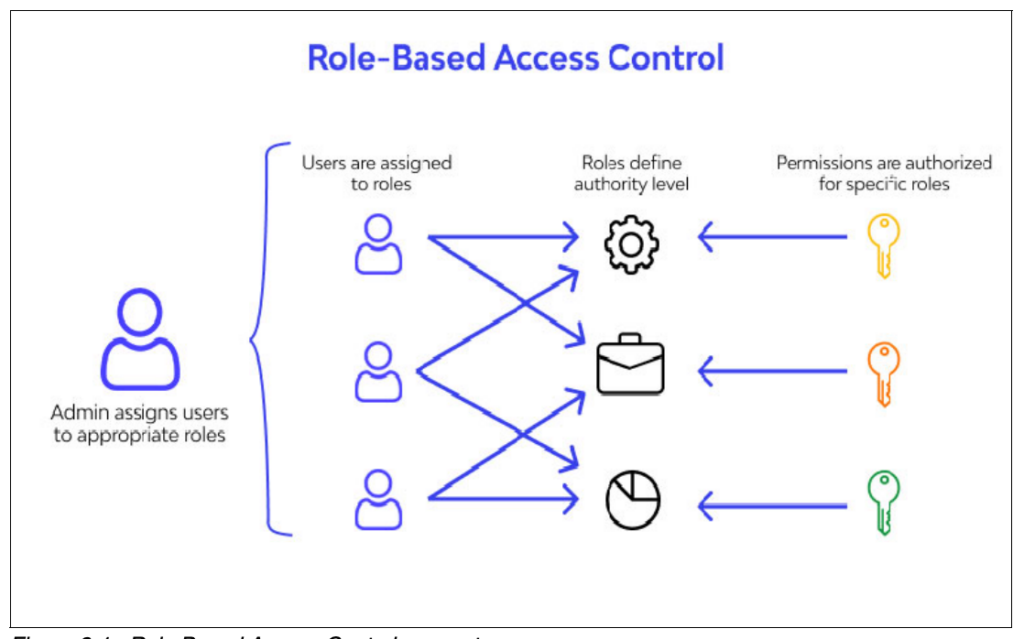
- Role-Based Access Control: At the core of this layer is Role-Based Access Control (RBAC), which enables fine-grainedpermission management across hypervisors, logical partitions (LPARs), and containerized workloads. Administrators can define roles with specific privileges, enforce least-privilege policies, and audit access across the stack, reducing the risk of unauthorized actions and privilege escalation.
- Within RBAC:
- Users are assigned to roles by an administrator based on their responsibilities or job functions.
- Roles act as intermediaries that define what a user is allowed to do within the system.
- Each role is associated with a specific set of authorizations or permissions, which determine access to resources or actions
- Within RBAC:
- Resource Isolation: To further enhance system resilience, Power11 enforces resource isolation through hardware-assisted virtualization. Each LPAR operates as an independent execution environment with dedicated resources, preventing lateral movement of threats and containing potential breaches. This isolation is reinforced by memory tagging, secure hypervisor boundaries, and cryptographic separation of workloads. Together, these features ensure that even in multi-tenant or hybrid cloud deployments, workloads remain secure, contained, and recoverable.
Storage and Data Protection
IBM Power11 integrates a comprehensive set of data protection mechanisms designed to
safeguard sensitive information across all stages of storage and access.
- IBM Power Cyber Vault: This software-integrated solution uses firmware telemetry for sub-minute ransomware detection in less than one minute, automating immutable snapshots and recovery via integration with IBM Storage. It follows NIST frameworks, detecting threats below the OS level. It uses AI-driven behavioral analysis to monitor I/O patterns for signs of encryption (ransomware) and creates immutable, “air-gapped” snapshots for instant recovery.
- Data-at-Rest Encryption: Power11 supports data-at-rest encryption across all storage tiers, including local disks, SAN volumes, and cloud-integrated storage. Encryption is performed using hardware-accelerated AES algorithms, and keys are managed through secure enclaves or external key management systems (KMS). This ensures that even if physical storage media is compromised, the data remains inaccessible without proper authorization. Combined, these features deliver a resilient and compliant data protection framework that aligns with enterprise security policies and regulatory mandates.
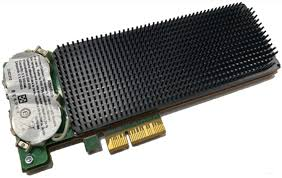
- IBM 4770 Cryptographic Coprocessor: For cryptographic operations and secure key management, Power11 supports the IBM 4770 Crypto Card, a high-assurance hardware security module (HSM) that performs real-time encryption, decryption, and digital signing. The card is compliant with FIPS 140-2 Level 4 standards and supports both traditional and quantum-safe algorithms, ensuring long-term cryptographic integrity. It also facilitates secure key lifecycle management – including generation, storage, rotation, and destruction – within a tamper-resistant environment, making it ideal for regulated industries such as finance and healthcare.
If you haven’t had a chance to check out my Elliptic Curve Cryptography and Quantum Cryptography and post-quantum cryptography blog posts, I’d suggest giving it a read first—it’ll really help you get a better grasp of the concept.
Conclusion
IBM Power11 is more than a performance upgrade; it is a future-proof foundation for the quantum era. By embedding NIST-approved algorithms into a multi-layered, hardware-rooted architecture, IBM provides organizations with the tools they need to protect their most sensitive data against the threats of today and the quantum challenges of tomorrow
Link for the IBM’s “Security and Cyber Resilience with Power11” Redbook can be found in the reference section.
- IBM’s Power11 Processor (IEEE Hot Chips 2025) IEEE Xplore / Computer Society
- IBM Spyre AI Accelerator Announcement (November 2025) IBM Newsroom / SigDA E-News
- IBM Quantum Roadmap & Quantum-Safe Standards (June 2025) IBM Quantum Blog
- IBM Power10 and Power11 Evolutionary Security (Technical Comparison) IEEE Xplore / Computer Society
- IBM Spyre AI Accelerator Announcement (November 2025) IBM Newsroom / SigDA E-News
- IBM Quantum Roadmap & Quantum-Safe Standards (June 2025) IBM Quantum Blog
- IBM Power10 and Power11 Evolutionary Security (Technical Comparison) Hot Chips Archive (POWER10 Reference)
- Security and Cyber Resilience with Power11 https://www.redbooks.ibm.com/redpieces/pdfs/sg248595.pdf